


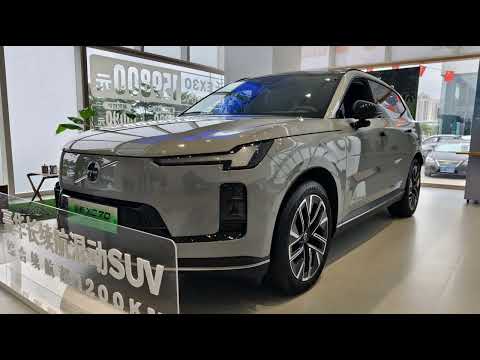
Volvo has launched its XC70 plug-in hybrid in China, marking the first production vehicle built on its new SMA super hybrid platform. This move is significant because it enters a highly competitive market where Chinese automakers are rapidly advancing in new energy vehicles. The XC70, positioned between the XC60 and XC90, stands out with its large-capacity plug-in hybrid system—up to 39.6 kWh of battery capacity and over 1,200 km combined CLTC range—a capability that few rivals in this price segment currently offer.
Зміст
Exterior Design and Dimensions
The XC70 measures 4,815 mm long, 1,890 mm wide, and 1,650 mm high, with a 2,895 mm wheelbase. Its front grille is closed for aerodynamic efficiency, while the “Thor’s Hammer” headlights feature adaptive matrix LED technology. Notably, the vehicle lacks roof-mounted lidar, indicating a cost-conscious approach to sensor technology. Wheel sizes range from 19 to 21 inches, primarily differing in airflow management rather than visual impact. At the rear, vertical “Viking axe” taillights ensure design consistency with Volvo’s global branding.
Interior Tech and Comfort
Inside, the XC70 features a 15.4-inch central touchscreen, a 12.3-inch digital instrument cluster, and a 92-inch augmented reality head-up display. The infotainment system supports four-zone voice recognition and AI-assisted route planning, with wireless Apple CarPlay included. A 23-speaker Harman Kardon audio system completes the tech package.
The retractable center console provides flexible storage options, while rear space benefits from the long wheelbase, improving legroom. The cargo area is wide enough for transverse loading, with a physical luggage cover retained for practicality. Interior materials, while well-fitted, use fabric in high-touch areas, which may show wear over time compared to synthetic alternatives.
Driving Performance and Powertrain
The XC70 is powered by a 1.5T hybrid engine paired with a three-motor (P1 + P2 + P4) layout. Output ranges from 234 kW to 340 kW, with the tested version reaching 0–100 km/h in approximately 5.3 seconds. Battery options include a 21.2 kWh pack (116 km CLTC range) and a larger 39.6 kWh pack (up to 212 km CLTC range). Fast charging from 0% to 80% takes around 23 minutes.
The powertrain delivers smooth, immediate torque in electric mode, with seamless transitions in hybrid mode. Suspension is tuned for European driving dynamics, providing directional feedback without excessive body roll. Steering is linear and predictable, managing the vehicle’s 2.2-ton weight effectively.
However, regenerative braking can feel nonlinear at low speeds, and wind noise around the A-pillar is noticeable above 100 km/h. The hybrid system supports multiple modes—pure electric, series hybrid, and engine direct drive—and can output up to 6 kW of external power.
Market Position and Recall
Priced from 269,900 to 349,900 yuan (37,100 to 48,200 USD), the XC70 competes with models like the Li Auto L7, Aito M7, and BYD Tang DM-i. Volvo’s offering stands out with a larger battery and globally standardized safety engineering. However, it lags behind Chinese competitors in advanced autonomous driving features.
A recent recall of 15,000 XC70 units in China due to a half-shaft defect highlights ongoing manufacturing quality control challenges. Despite this, Volvo plans to export the XC70 to over 70 global markets, positioning it as a test case for its SMA hybrid architecture. The model’s competitive pricing—with over 200 km of electric range and a three-motor hybrid system—makes it a unique offering among joint-venture SUVs in the Chinese market.
The XC70’s launch is more than a regional strategy; it’s a global validation of Volvo’s next-generation hybrid technology.


