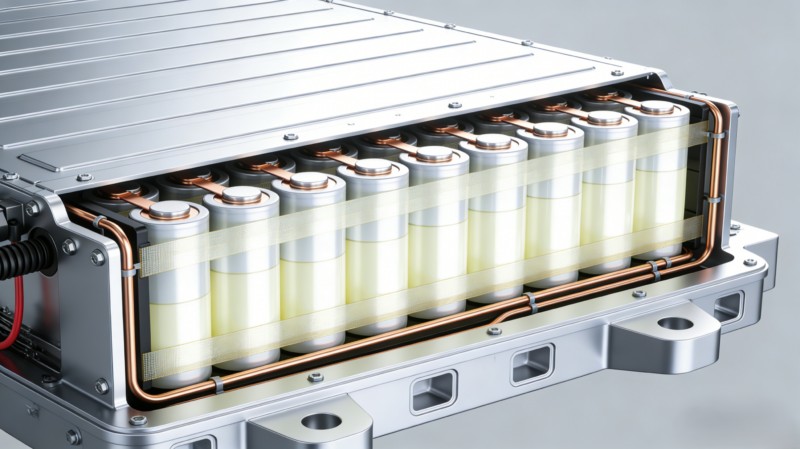
A research team from the Chinese Academy of Sciences has achieved a significant milestone in battery safety, developing a sodium-ion battery capable of completely suppressing thermal runaway. According to findings published in Nature Energy, the new technology successfully survived extreme testing conditions, including temperatures reaching 300°C, without smoke, fire, or explosion.
Зміст
Solving the “Thermal Runaway” Problem
In the current battery landscape—dominated by lithium-ion technology—thermal runaway is the most critical safety hurdle. This occurs when an internal failure causes a rapid increase in temperature, triggering a self-sustaining chain reaction that leads to fire or explosion.
While most manufacturers attempt to mitigate this risk using flame-retardant additives, these are often “reactive” measures that merely delay ignition. The new approach developed by Hu Yongsheng and his team at the Institute of Physics is “proactive.”
The Science: A Self-Shielding Electrolyte
The core innovation lies in a polymerisable non-flammable electrolyte (PNE). This material acts as a multi-layer protection framework through a unique physical transformation:
- Phase Transition: When internal temperatures climb above 150°C, the electrolyte transitions from a liquid state into a solid-state barrier.
- Physical Isolation: This new solid layer acts as an internal separator, physically blocking heat from spreading between cells and halting the chemical chain reactions that drive thermal runaway.
- Structural Integrity: Unlike traditional methods that focus on slowing down a fire, this mechanism is designed to interrupt the failure pathway entirely.
Proven Performance Under Extreme Stress
The technology was tested using a 3.5 Ah cylindrical sodium-ion cell, and the results suggest a new standard for safety:
– Nail Penetration Test: The cell showed no signs of smoke, fire, or explosion even when physically punctured.
– Extreme Heat: The battery maintained stability at temperatures up to 300°C.
– Operating Range: Despite the enhanced safety, the cell remains highly functional, operating reliably from -40°C to 60°C.
– Energy Density: The cell achieved an energy density of 211 Wh/kg, proving that high safety does not necessarily require a massive sacrifice in power.
The Path to Commercialization
This breakthrough is not just a laboratory curiosity; it is closely linked to Zhongke Haina (HiNa), a sodium-ion battery developer emerging from the same research institute.
The shift toward sodium-ion technology is driven by the need for cheaper, more abundant alternatives to lithium. While lithium remains the gold standard for high-performance EVs, sodium-ion batteries are carving out a niche in heavy transport and large-scale storage. HiNa has already reported that in heavy truck testing, sodium-ion systems helped reduce energy consumption per kilometer by approximately 15% and extended range by roughly 20% under standard conditions.
The Economic Outlook
The transition to sodium-ion will depend heavily on cost-efficiency. Industry projections suggest:
1. By 2027: Sodium-ion batteries are expected to reach cost parity with lithium-ion systems.
2. By 2028: As production scales, the price ranges of both technologies are expected to overlap significantly.
This development marks a shift from merely managing battery fires to fundamentally preventing them through material science, potentially paving the way for safer, cheaper energy storage in heavy industry and transport.
Conclusion
By creating an electrolyte that turns solid during overheating, researchers have addressed the primary safety flaw in high-density batteries. As sodium-ion technology approaches cost parity with lithium, this safety breakthrough could accelerate the global transition toward more stable and affordable energy solutions.