


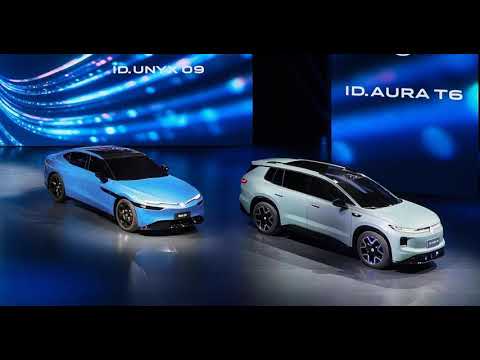
Volkswagen Group is launching one of its most ambitious product rollouts in history, specifically designed to combat the rising dominance of domestic Chinese EV manufacturers. Under the guiding principle of “In China, For China,” the automotive giant is pivoting away from global standardization toward a localized, high-tech strategy tailored to the unique demands of the Chinese consumer.
This shift is a direct response to a changing landscape: in 2023, BYD overtook Volkswagen as the top-selling brand in China, signaling that traditional automotive powerhouses must evolve rapidly or risk obsolescence in the world’s largest EV market.
Зміст
A Rapidly Expanding Electric Portfolio
The scale of Volkswagen’s commitment is reflected in its aggressive launch schedule. The Group aims to introduce approximately 30 electrified models by 2027, a number expected to grow to 50 models by 2030. This lineup will include a mix of plug-in hybrids, extended-range vehicles, and roughly 30 pure electric models.
To achieve this, Volkswagen is leveraging strategic partnerships and local joint ventures to accelerate development cycles:
- FAW-Volkswagen: Developing the ID. Aura T6, a mid-size electric SUV built on the new China Electronic Architecture (CEA).
- Volkswagen Anhui (with JAC Motors): Co-developing the ID. Unyx 09, a five-meter electric sedan designed in just 24 months.
- Xpeng Partnership: Collaborative efforts have already yielded models like the ID. Unyx 08, which features high-performance 800V architecture and premium battery technology from CATL.
The Intelligence Race: AI-Defined Vehicles
A central pillar of this offensive is the transition from “hardware-first” to “AI-defined” vehicles. Volkswagen is moving beyond simple driver assistance to a sophisticated software ecosystem.
Starting in the second half of 2026, vehicles built on the CEA platform will feature an “AI Agent.” Unlike traditional voice commands, this agent will use a locally trained Large Language Model (LLM) to:
– Understand natural language and user intent.
– Execute complex, multi-system tasks through conversation.
– Make contextual decisions to assist the driver proactively.
By 2027, the introduction of CEA 2.0 is expected to unify intelligent driving and the cockpit experience onto a single, powerful computing platform, aiming to match the seamless digital integration found in Chinese domestic brands.
Brand Diversification: From Budget to Luxury
Volkswagen is not just focusing on its flagship brand; it is restructuring its entire portfolio to cover every segment of the Chinese market:
1. The Entry-Level Segment: Jetta
To capture the budget-conscious electric market, Volkswagen is revitalizing the Jetta brand. With the reveal of the Jetta X concept, the brand aims to leverage its reputation for affordability to launch four new electrified models by 2028.
2. The Premium Segment: AUDI
In a significant move, Audi is developing the AUDI brand—a specific, China-only entity—to compete in the high-end intelligent EV space. The recently previewed E7X electric SUV, developed alongside SAIC, represents this push. The E7X is designed to offer:
– Level 3 highly automated driving capabilities.
– High-performance powertrains (up to 500kW).
– An “AI-powered, immersive smart cabin” developed at a new dedicated innovation center in Shanghai.
Conclusion
Volkswagen’s strategy represents a fundamental shift from global uniformity to radical localization. By integrating Chinese software expertise, forming local partnerships, and deploying AI-driven technology, the Group is fighting to maintain its status as the leading foreign automaker in a market increasingly dominated by domestic innovators.


