


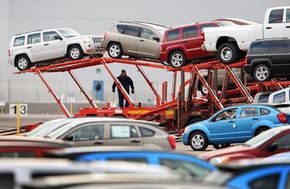
It feels weird when you stop and think about it. We buy cars because we want to drive them. But before that first key turn, millions of machines were packed into trucks, trains and ships. This is a logistical nightmare that happens every year.
The reason is simple. A brand-new car driven from the factory to the dealership is technically used. As soon as the odometer turns over, it loses its value. That’s why car manufacturers transfer them to transport vehicles.
In 2007 alone, 16.1 million new cars were exchanged. Most came from 71 assembly plants in North America. Some come from Europe and Asia. All must be delivered to 14,285 new car dealers in the United States.
Look at Ford Motor Co. The company has 13 complete manufacturing facilities throughout North America. That’s 2.5 million cars. Cars, trucks and SUVs must reach 4,000 dealers. It’s not like dropping off a pallet of paper towels at the grocery store. Dealers order specific configurations. The route must be exact. One wrong turn, one delayed shipment and the whole chain jerks.
Automakers spend billions of dollars moving these machines. You pay for it directly through the destination charge. The price is indicated on the window sticker, formally known as the Monroney label.
Here is the kicker. The charge you see doesn’t reflect the actual cost of move that specific vehicle from the factory to the local dealer. This is a national average calculated by proprietary formulas.
The destination charge is a flat rate based on vehicle type, not distance.
Large pickup trucks cost more to transport than small compact cars. But the price is the same whether you buy the truck 1 mile from the assembly plant or 2,000 miles away. Also note that these fees only apply to shipments within the United States.
The competition in the car trade is very fierce. Automakers keep destination charges as low as possible because they are included in the manufacturer’s suggested retail price (MSRP). A higher MSRP can make the car less attractive to buyers.
But not only new cars move. Used cars travel the country too.
In 2007, ADESA Analytical Services reported that nearly 42 million used vehicles were sold in the United States, approximately one-third of which were sold through franchised dealers. Another third passed through 42,751 independent used car dealers. The rest were sold by private individuals.
Used cars don’t just go from seller to buyer. They hop on transporters multiple times. They move to auctions. They move to wholesale operations. Then, finally, they land at a dealership lot.
Зміст
Methods of Auto Transport
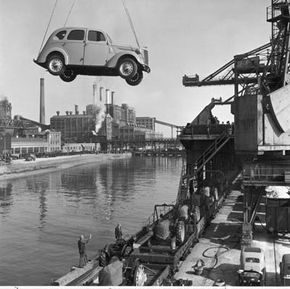

Most cars move on four wheels or sit still in the driveway. But when they have to cross oceans or continents, the mechanisms change. Airplanes, giant cargo ships, railroad cars, and heavy trucks are all involved in moving a vehicle from point A to point B.
The presidential motorcade is an obvious anomaly. These armored limousines are available for all trips outside of Washington, D.C., flown on Air Force C-5 Galaxy cargo planes. For most people, this is an exaggeration. Very few private vehicles see inside a cargo plane. Exceptions are special vehicles: exotic collector cars, racing cars or individual concept cars intended for large car shows.
Fleet delivery
Marine vessels are the backbone of the global car trade. Some of these vessels can hold up to 8,000 vehicles. Most of them are built for 4,000 to 5,000 vehicles. They are the primary method of bringing foreign-made cars and trucks into the United States.
Take Toyota. In 2008, the company imported approximately 1.1 million vehicles directly from Japan to America. To transport that much metal, Toyota leases or forwards up to 30 vessels. These ships dock at five specific ports: two on the east coast and three on the west. As soon as the vehicles are unloaded, they are switched to trucks or rail for the final journey to the dealer.
Dominant position in railway traffic
In the USA, logistics is moving again. Automakers estimate that 65 to 70 percent of all new vehicles sold in the country will be transported by rail before the 18-wheel car transporter trailer is finally delivered.
Truck traffic has its charms. The average distance is within 250 miles of the pickup point. In addition, costs are increasing. Longer distances are cheaper by train. Of course, the track is not perfect. There are restrictions on destinations, and proper loading and unloading of vehicles requires special equipment.
We have covered how vehicles move from one place to another. Next, we look at the specific advantages and challenges of rail transport.
Traveling by train
Weekend oil change price
Sometimes logistics is about efficiency. Sometimes they are just about excess.
In late July 2008, London newspaper The Sun reported a story that outraged environmentalists. A wealthy resident of Qatar paid about $42,000 to have his Lamborghini LP640 airlifted to London. Why? For an oil change.
The oil change itself only cost $6,500. The rest was the privilege of flying a 6,500 mile round trip on a weekend. The carbon footprint left by this single supercar service was huge. Critics pointed out that it is absurd to burn fuel to transport a vehicle around the world just to change the filter. It was a stark reminder of how far car culture can stretch when money is no obstacle.
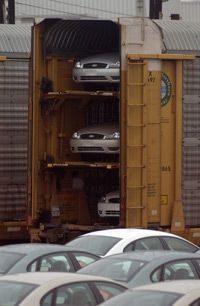

It is a common misconception that trains were the new form of transportation that Americans saw on the road. While it is true that many vehicles are transported by rail, automobiles play a small role in the overall picture of freight transportation in the United States. According to the Association of American Railroads, cars accounted for only 1.6% of the total tonnage of railroads in 2007. Railroads transported huge amounts of steel, coal, and grain. Cars? Not so much.
However, the use of rails can be very effective.
The main focus here is the auto racks. those long, multi-level cars you see on freight trains. There are two or three floors. Two-story units typically accommodate trucks and large SUVs, while three-story units accommodate standard passenger cars. Capacity varies, but the average is 12, but each can hold up to 20 vehicles.
Let’s do the math. A separate car transport train with 70 such racks can transport more than 800 vehicles at once. The average mileage of new cars is around 1,300 miles. It’s a long way to the dealer.
Loading the Iron Horses
这些金属野兽从哪里开始他们的旅程? 通常就在装配厂。 汽车通过特殊坡道驶入racks。 一旦进入内部,它们就会被锁定在甲板地板上的轮挡固定。 没有滚来滚去。
有时,物流会变得混乱。 新车可能会被卡车运到铁路站装卸码头。 从那里,他们被推上坡道并被锁定。 这是一个紧张的操作。 每一寸空间都被考虑在内。
Auto-Max Innovation
The industry does not stand still. The latest generation auto racks is Auto-Max, developed by Honda and Greenbrier. This model increases the capacity to 22 cars. how? Maximize the space between the axles of rail vehicles to effectively support cars and trucks.
Honda has ordered 400 of these. They boast an 82 percent rail-shipping rate, which is the highest among car manufacturers. Why switch from trucks? efficiency. Reducing the carbon footprint. You also have fewer drivers.
The Truck Alternative
但铁路并不是唯一的选择。 当速度或与经销商的距离比数量更重要时,卡车就会占据主导地位。
Going by Truck

The Logistics of the Road
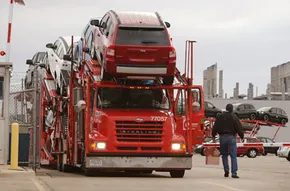
The journey from factory floor to dealership lot involves millions of highway miles. Toyota alone logs 45 million miles annually just to move its 2 million units across nearly 1,500 locations. That is a lot of asphalt. Most of that travel happens on tractor-trailer auto transporters. These rigs are engineering puzzles in their own right. A standard double-decker can haul up to twelve vehicles. The tractor supports four, while the trailer holds eight on two levels. Hydraulic ramps make the process possible. They lower for loading and tilt to tuck the rear of one car under the front of another, squeezing every inch of space.
The driver turns this into a high-stakes 3D puzzle. You cannot load the first delivery as the first car, or you trap the rest of the cargo. Size matters too. Larger vehicles ride on the top deck to avoid clearance issues with the lower deck. Some cars go in nose-first. Others are backed in. An experienced pro can secure a uniform load in ninety minutes. A mixed bag of different sizes? That can take four hours. The fear of vehicles falling off is real for drivers behind these giants. But it is rare. Each car is anchored at four points.
Security varies by vehicle value. Mass-market cars use chains with specialized hooks that fit specific tie-down holes in the chassis. These are ratcheted tight at precise angles. Luxury brands demand a gentler touch. Instead of chains, high-strength straps go over the tires. No metal touches the paint. No scratches. No dents. Even when these heavy rigs flip, the securement systems usually hold. The cars stay put.
Custom Carriers and Race Teams
Not all transporters are built for volume. High-end racecar haulers, like those for NASCAR and Indycar, are enclosed aluminum beasts. They feature two decks. The upper level lifts electrically to store two cars. The lower deck is a workshop. It holds cabinets, power tools, and crew lounges. These are mobile garages.
Hiring a Transport Service
Millions of vehicles move annually for personal reasons. Families relocating cross-country. Students heading to distant colleges. Snowbirds fleeing north for the sun. Corporate relocations. For these one-off needs, owners often hire a transport company. Or they call a broker. There is a difference. A transport company moves the car. A broker sells the job to a carrier.
Carriers offer control and accountability. If damage occurs, they answer for it. Brokers offer speed and options. They have access to a wider network. Regardless of who you choose, verify references. Fraud is a risk. And there are rules. You cannot pack clothes or appliances in the trunk. The fuel tank must not be full. You must be present for the final inspection.
Some enthusiasts buy their own trailers. Single-car haulers come in various styles. The trick is matching the trailer weight to the tow vehicle’s capacity. If you don’t want to tow, there is another way. Driveaway agencies provide drivers. They screen candidates and match them to your schedule. The drivers aren’t paid. They cover their own gas. But they get to drive your car across the country. It’s a trade-off.
Aerodynamic Innovations
Personal trailers are notoriously inefficient. They look like bricks. Pete Brock, the designer behind the Shelby Daytona coupe, disagrees. He created the Orca. It is sleek. Light. Aluminum. The design borrows from racecar aerodynamics and the dorsal fin of a classic Bugatti Atlantique. It reduces drag. It cuts through the air differently. It might just change how we think about towing.
The reality of transport risks
Most people believe that moving cars is dangerous. This is not true. In fact, the industry’s record is pretty clean. If something goes wrong, it’s almost never the truck’s fault. Most damages and accidents are caused by human error. However, rare disasters do happen. When it happens, they are spectacular.
Car carriers can sink.
In December 2002, the Norwegian cargo ship “Tricolor” collided with the container ship “Kariba” in the English Channel. The carrier went under in just 30 minutes. More than 2,000 luxury cars were lost to the bottom.
Eight months later, in November 2002, the Hual Europe ran aground near a Japanese island due to a typhoon. A fire broke out. About 3,700 vehicles were destroyed.
Then in May 2004 MV Hyundai No. 105 collided with an oil tanker near Singapore. The ship sank with around 4,200 cars on board.
Rail transport is safer, but not immune. Train cars can collide with overpasses. The roofs of loaded vehicles get crushed. Fatal accidents in auto transport are statistically low compared to other cargo haulers. A 2005 government report listed 4,932 fatal crashes involving large trucks. Only 31 involved auto carriers. It is 0.6%. The data for 2006 are similar. There were 4,732 fatal accidents. 40 involved carriers. 0.8%.
Injuries can also happen. Vehicles can fall from open trailers during loading. Forklift trucks are often used to transport broken down vehicles. Workers slip off upper decks. Or ramps drop if safety pins are missing. The new Boydstun trailer solves this problem with hydraulic rams and screw drive technology. No pins are needed. Internal locks prevent sudden drops.
Even on open trailers, damage is low. Ford and Toyota report that 99.7 to 99.88 percent of new cars arrive undamaged. Drivers are encouraged to keep their vehicles on time and clean. Some car manufacturers wrap their cars in plastic. A heavy tarpaulin protects the bottom row from road debris. Luxury models often ride in enclosed trailers.
車が限界を超えたとき
2006 年 7 月、マツダは 4,700 台以上の新車を失いました。 クーガーエース アリューシャン列島でボートが転覆しそうになった。 1ヶ月ほど横に吊るされていました。 ボートは救われた。 車両は撤去されました。 しかしマツダは一台も売れなかった。 もうそれほど新しくはありません。 使用されていません。 どんなに損傷しているように見えても、塩水にさらされるとダメになってしまいます。
The future of motorized transport
The industry is developing slowly. But change is coming. Officials are pushing for cooperation. A generation ago, automakers refused to share trailers. They want brand exclusivity. But half-empty trucks cost money. They waste fuel.
Now everyone wants to fill their trailer. Ford’s Walter Lowe put it succinctly: “We don’t compete on the truck. We compete in the showroom.”
The future is like an airline hubs. hub-and-spoke network. GPS and cellular tech make this much easier. Dispatchers monitor trucks in real time. They coordinate pickups and deliveries faster. Computer modeling optimizes routes. Less fuel. More on-time deliveries.
The equipment does not change much. The ship will also be bigger. Trailers likely won’t, due to highway regulations. However, safety will improve. Better ramp controls. Safer footing. Padding in new designs will reduce loading damage.
Trucks are greener. Clean diesel engines. Biofuels. Better exhaust gas handling. A hybrid model will also follow. Think of the technology in Toyota’s Prius. It’s a big device though. The electric motor handles acceleration and slow speed. The diesel engine starts to spin. Efficiency has increased.
尺寸限制和规定
美国汽车运输拖车受到法律限制。 你不能把它们建得更大。 在美国东部,装载高度最大为 13.5 英尺。 西14英尺。 总长度(包括拖拉机)为 75 英尺。 你有四英尺的后悬。 前悬三英尺。 宽度固定为 102 英寸。 梯子等安全设备不计入该限制。 满载总重量不能超过 80,000 磅。
Logistics of lost and scrapped vehicles
The road to movement is not always easy. In some cases, it can turn into water.
In November 2002, a cargo ship fire destroyed 1,997 Kia vehicles. A few months later, in December 2002, a shipwreck took luxury cars down with it. Then in May 2004, another carrier carrying 4,190 vehicles sank off the coast of Singapore.
These are not just statistics. They are hulls filled with metal and leather.
The consequences are serious. Mazda learned this firsthand in 2006 when the vessel Cougar Ace listed heavily. All vehicles on board were deemed a total loss. They headed straight for the crusher.
This is where the salvage industry comes into play.
Companies like Tricolor Salvage specialize in recovering these lost fortunes. They don’t just pick up wrecks. They dive. Assess structural integrity. They decide what to keep and what to discard.
For the average buyer, this is important.
When you buy a new car, the “destination fee” on the sticker is more than just a profit. It covers the complex dance of logistics. From factory floors to ports, ships, railways and retailers.
Honda knows this well. The company’s Auto-Max fleet is designed to efficiently transport vehicles across the continent. However, efficiency does not guarantee safety.
The ship sank. A fire broke out. Trucks jackknife.
Heavy equipment and cranes
Who moves these giant ships?
Wallenius Wilhelmsen Logistics launched one of the world’s largest car transport ships in 2008. These ships are floating parking lots. They transport thousands of units simultaneously.
Things are different on land.
Boydstun Metal Works manufactures trailers that are used to move cars when they arrive at the dock. These are not your standard flatbeds. They are multi-level beasts. There is room for 10 vehicles. Or even more.
Featherlite Trailers offers a glimpse of the design behind it. These transport vehicles must be strong enough to support the weight, yet light enough to be towed without consuming a month’s worth of diesel fuel.
Who is the driver behind the wheel? They are a special breed.
United Auto Transport employs crews who can navigate tight spaces and unpredictable weather. If you make a mistake, you won’t just be late. You’re in a lawsuit.
The Association of American Railroads tracks Class I statistics. The railway is still a significant player. Trains carry cars in closed boxcars. Weatherproof. It’s safe. It’s slow.
Boats are faster. But they are at the mercy of the sea.
Why cranes are important
The car transporter cannot be loaded with a forklift.
The car is too big. The decks are too high.
Enter the heavy lifters.
ArvinMeritor worked on a dual-mode, heavy-duty diesel-electric powertrain for Walmart. It’s not a car. But the principles are the same. Efficiency under load.
For car carriers, the loading process is precise.
Crane operators place each vehicle in place. They secure the straps. They check the weight distribution. Uneven loading can cause the boat to capsize.
It’s not just about getting the car going.
This is to get them there intact.
When that ship sinks, the insurance claims are massive.
The salvage crews work in shifts. They pump water. They cut steel. They recover what they can.
Sometimes, it’s nothing.
Sometimes it’s a few pristine models.
The rest?
They were crushed.
Logistics labor costs
It’s not just about the money.
The dangers were highlighted in the 2003 Oregon Fatality Assessment and Control Evaluation report.
Truck accidents are real.
The U.S. Dept. of Transportation released the facts about the 2005 and 2006 accidents. Large trucks are involved in thousands of accidents.
When a car hauler crashes, the debris field can be very large.
It blocks highways. Delivery is delayed. It ruins lives.
Drivers work long hours. They are paid by the mile. They strive to meet deadlines.
The manufacturers push back.
Kia lost almost 2,000 vehicles. Mazda lost its entire “Cougar Ace” shipment.
These losses ripple through the market.
Supply chains are tightening. Prices fluctuate.
You can feel it in motion.
Delivery delays. Prices are going up.
It all starts with the boat. or a truck. Or a crane.
The future of transport
Will there be a new invention?
Who invented the 18-wheeler?
Industry is paying attention.
Honda’s Auto-Max fleet is a step forward. Electric transmission is another.
However, the core problem remains.
Travel long distances without damaging heavy objects.
Or kill someone.
Scrap power is getting smarter. Tricolor Salvage uses advanced technology to restore value from products that cannot be recycled.
The railways have been optimized.
Trucking companies train better.
But what about the ocean?
The sea doesn’t care about your logistics plans.
It waits.
The collision causes the car to collapse.
It’s not a question of whether it will happen again.
It’s just the right time.
Who cleans up the mess?


