Зміст
Style Over Space
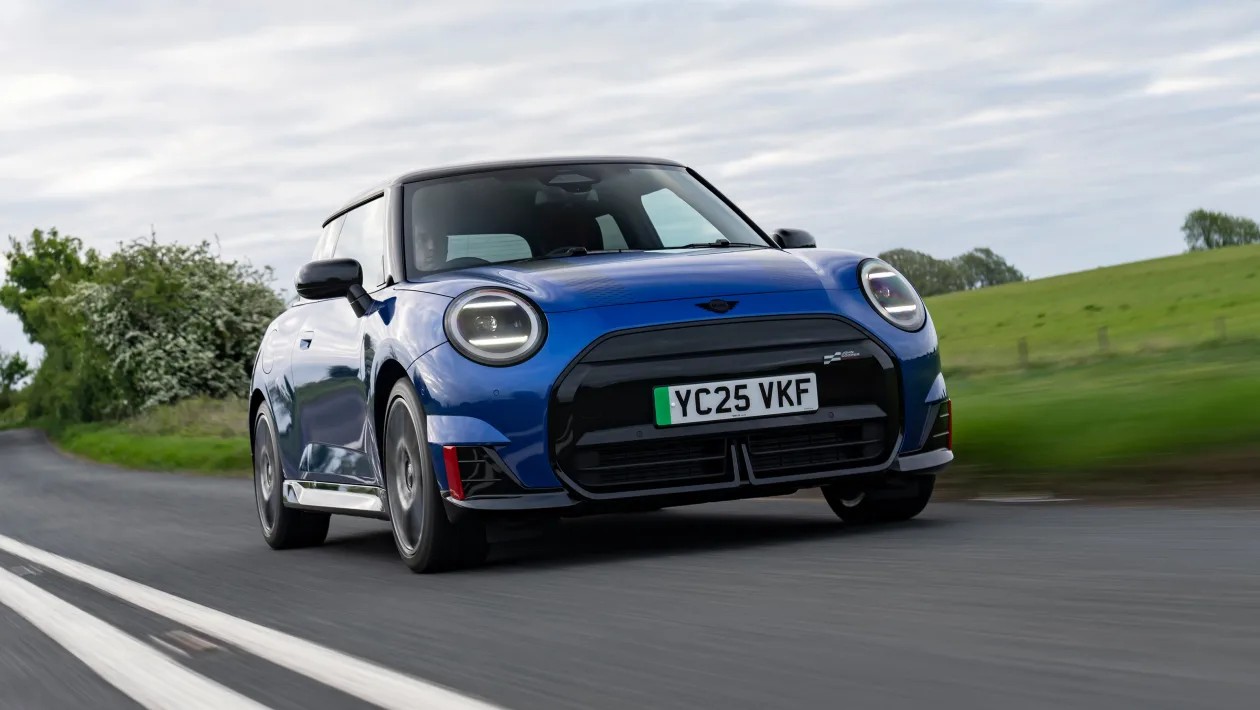
The Mini Cooper Electric costs you extra. £1,700 extra. But you’re buying that sophisticated fun vibe that has kept this brand relevant for twenty years. It is not big. The battery is modest. Don’t expect practicality awards. Range? Also not winning prizes. But it oozes quality. And it feels like a Mini. That matters more than you’d think.
Minis try too hard to look like they’re from 1960s London. Probably. But this iteration is neat. Thanks to the new five-door Aceman sitting above it, designers could keep the three-door tiny. Roughly the same footprint as before. Less chrome. Less nonsense. It mixes cute with smart. Still bigger than the Fiat 5000e though. Over 20cm longer. If you just want tiny, buy the Italian car.
The angles trick you. Front on? Short. Squat. Classic Mini silhouette. Slide around to the side and the lie becomes obvious. Huge front overhang. A long wheelbase to hide the battery pack. Physics doesn’t care about retro styling.
It beat a Peugeot E-200008 head to head in a recent twin test. Why? Better driver engagement. A fancier cabin. It still works.
How Much Cash?
Three setups. A confusing mess of ‘Styles’.
Start at around £26900 for the base Cooper E in Classic trim. That’s your entry point.
At the top sits the John Cooper Works (JCW). The hot one. Just one config. Costs £34900+. You can save some dough by building it via the Auto Express service. Leasing deals exist too. Do the math.
Driving Impressions
Does it go-kart? Sort of.
The car is heavy. Nearly 1700kg for the entry level. You can feel that mass in corners. The laws of physics are non-negotiable. Yet. It still tucks into a corner nicely. The front end grips hard. Minimal body roll. It handles better than most EVs when changing direction quickly.
The steering? Sharp. Heavy at slow speeds. Annoying when parking.
The ride? Firm. Very firm. You feel every single bump in the road. Mini engineers nailed the pedals—great feedback in stop-start traffic. But the suspension? Unforgiving.
It’s a small car carrying double the weight of its petrol ancestor, yet it somehow ignores gravity when turning into bends.
Power comes instantly.
- Cooper E: 181bhp. 0-62mph in 7.3s. Front wheel drive. Nippy enough to pass slow vans.
- Cooper SE: 215bhp. 6.7s. A bit peppier. Still front drive.
- John Cooper Works: 254bhp. 5.9s. Hot by Mini standards. Modest for an EV supercar, but perfectly pitched here.
Even the base model has enough torque to feel alive. Silent mode removes artificial whirrs. The refinement is good. Too good? Maybe. It lacks the chaotic joy of a petrol Mini, but it’s pleasant.
Country roads reveal the truth. Traction is decent, but in the wet, the front wheels will spin under heavy throttle. Understeer creeps in. Manageable, but don’t drive it like it’s the Le Mans prototype.
Highway driving? Forget it.
The firm suspension translates into porpoising on wet tarmac. Constant pattering on smooth surfaces. It wears on you quickly. If you want long-distance comfort, look elsewhere. Small wheels help, barely.
Range and Charging
Mediocre. That is the verdict on the numbers.
The JCW manages 230 miles. The Renault 5 goes further (252 miles). The Alpine A290 gets 235. The Mini is behind the French pack.
The Cooper SE hits 242 miles.
The entry-level Cooper E drops to 182 miles claimed. In our real-world testing? 165 miles average. About 4.5 miles per kWh. Close to the promise. But the promise itself is weak.
Good news: Every model gets a heat pump. Cold weather range will be less painful because of it.
Charging is average. 75kW max for the base model. 95kW for SE and JCW. A 10-80% fill takes roughly half an hour at a fast charger. Reasonable.
At home on a 7.4kW wallbox? Six hours for the E. Eight for the bigger batteries. Plan ahead.
The Inside
Premium feel. Undeniably so.
The cabin feels upmarket. High-grade plastic. Soft touches where it counts. Even the base Classic trim feels engineered well, if a bit dark. Weave patterns on the dash are cool to touch, boring to look at for hours. Higher trims add brighter accents.
The screen? It’s a nine-inch round OLED disc. Very Mini. Crisp. Fast. The graphics fly. The processor is grunt-y.
The interface? A mess.
You tap the screen for temperature control. Why? A knob would take two seconds. The screen takes three. And voice assistant Spike is… slow. It takes forever to register a command.
Head-up display comes with the SE trim. A good idea. It helps compensate for the weird layout if you’re new to the brand.
Practicality
It’s a Mini. Don’t bring expectations.
Four passengers fit. Barely. Two adults and a child is the limit for sanity. Isofix points in the back. Front row space is fine for the segment.
Boot? Tiny.
Fold the seats down: 800 litres. A two-seat layout should give more. It doesn’t. You won’t fit a large sofa. You might fit a suitcase and some groceries.
Insurance sits between groups 21-26. Cheap for what you’re buying. Tax-free under VED. No £50k luxury tax hit for the JCW either. BiK tax rates are lowest possible.
Depreciation? Actually good. Retains 47-53% after three years. Petrol Models tank harder. The EV holds its value better than the combustion engine variant.
Is it the most logical car you could buy? No. It’s a toy. An expensive, slightly compromised, beautifully engineered toy. You aren’t buying the Mini Electric for its efficiency specs or its boot space.
You’re buying it because it drives like nothing else, and looks good doing it.
Does that matter?