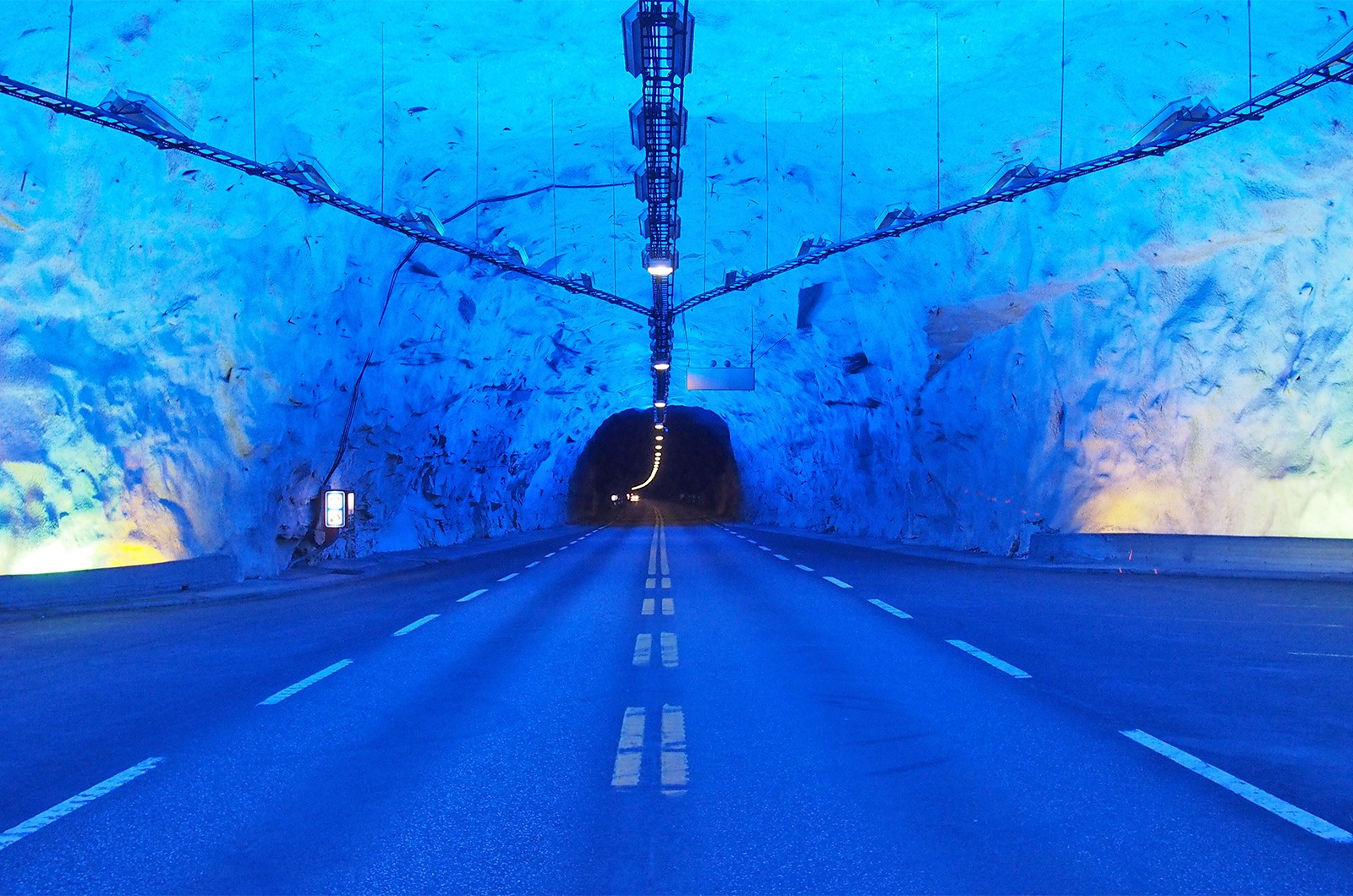
Road tunnels are a critical part of modern infrastructure, enabling travel through challenging terrain and reducing commute times. While many tunnels offer short underground stretches, some extend for miles, representing remarkable feats of engineering. Here’s a look at ten of the world’s longest road tunnels, highlighting the technologies and challenges behind their construction.
Ryfylke Tunnel, Norway – 8.98 Miles (14.46 km)
The Ryfylke Tunnel currently holds the title of the longest undersea road tunnel globally, stretching nearly 9 miles between Stavanger and Ryfylke in Norway. The tunnel was built to reduce reliance on ferries connecting islands in the region, as part of the larger Rogfast project.
Opened in 2019 after seven years of construction, it cost approximately £460 million (6.4 billion Norwegian Kroner). The tunnel features two separate tubes, each with two lanes, capable of handling up to 10,000 vehicles daily. Tolls are collected to help recover construction costs, with electric cars receiving a 50% discount. Descending to 285 meters below sea level at its deepest point, the Ryfylke Tunnel exemplifies modern subsea engineering.
Zigana Tunnel, Turkey – 8.99 Miles (14.48 km)
The Zigana Tunnel in northern Turkey bypasses the snow-prone Zigana Pass, shortening journeys by about five miles and reducing summer travel times by around 20 minutes. Completed in 2023 after starting construction in 2016, it stands as Turkey’s longest road tunnel at 8.99 miles.
Built using the New Austrian Tunnelling Method, the Zigana Tunnel adapts to surrounding rock formations during excavation, reinforcing walls with spray-on concrete. The tunnel includes two separate tubes for opposing traffic flows, 16 laybys in each tube, six ventilation shafts, 40 connecting tunnels, and nine transformer rooms for electrical power.
Muzhailing Tunnel, China – 9.46 Miles (15.22 km)
The Muzhailing Tunnel in China’s Gansu Province presents unique challenges due to its high-altitude location and active seismic zone. Completed using NPR anchor cabling technology, the tunnel secures its structure into the surrounding rock, allowing it to withstand ground deformation caused by earthquakes.
Like most modern road tunnels, the Muzhailing Tunnel consists of two separate tubes for opposing traffic directions. The use of advanced anchoring systems ensures stability in a geologically active region, demonstrating resilience in extreme conditions.
These three tunnels showcase how modern road construction overcomes geographical and geological hurdles.
These projects demonstrate the ongoing need for infrastructure development to facilitate efficient travel in challenging environments. As technology advances, these tunnels will likely be surpassed in length and complexity, pushing the boundaries of civil engineering.