The Japanese automotive industry is renowned for reliability, and this extends to its sports cars. While some models have proven more durable than others, the Mazda MX-5 Miata stands out as a low-drama, long-lasting option that also happens to deliver exceptional driving enjoyment. In a market with diminishing choices for affordable, two-door sports cars, the Miata remains a compelling pick for those seeking a blend of dependability and fun.
Зміст
A Legacy of Reliability
The MX-5 has earned a reputation for durability, and the 2026 model continues that tradition. According to iSeeCars, the Miata receives an impressive 7.8 out of 10 reliability rating, surpassing competitors like the Toyota GR86/Scion FR-S/Subaru BRZ (7.3). Newer models, such as the Nissan Z, currently lack sufficient data for a comprehensive evaluation. The Miata’s longevity is estimated at 16.7 years or 115,270 miles, with a 3.7% probability of exceeding 200,000 miles. This is no accident; the car’s enduring appeal rests on its fundamental simplicity.
Engineered for Longevity
The MX-5’s reliability isn’t just luck; it’s a deliberate design choice. The engine is based on Mazda’s well-established 2.0-liter Skyactiv-G four-cylinder, used across numerous models. This mature powertrain benefits from abundant parts availability and a decade of refinement, reducing the risk of recalls or inherent defects.
The engine bay is also designed with maintenance in mind. The layout provides easy access to key components, making DIY repairs straightforward for owners or minimizing downtime for mechanics. This contrasts sharply with more complex vehicles like the Subaru BRZ/Toyota GR86, whose boxer engines are notoriously difficult to service due to limited space.
Timeless Design and Constant Refinement
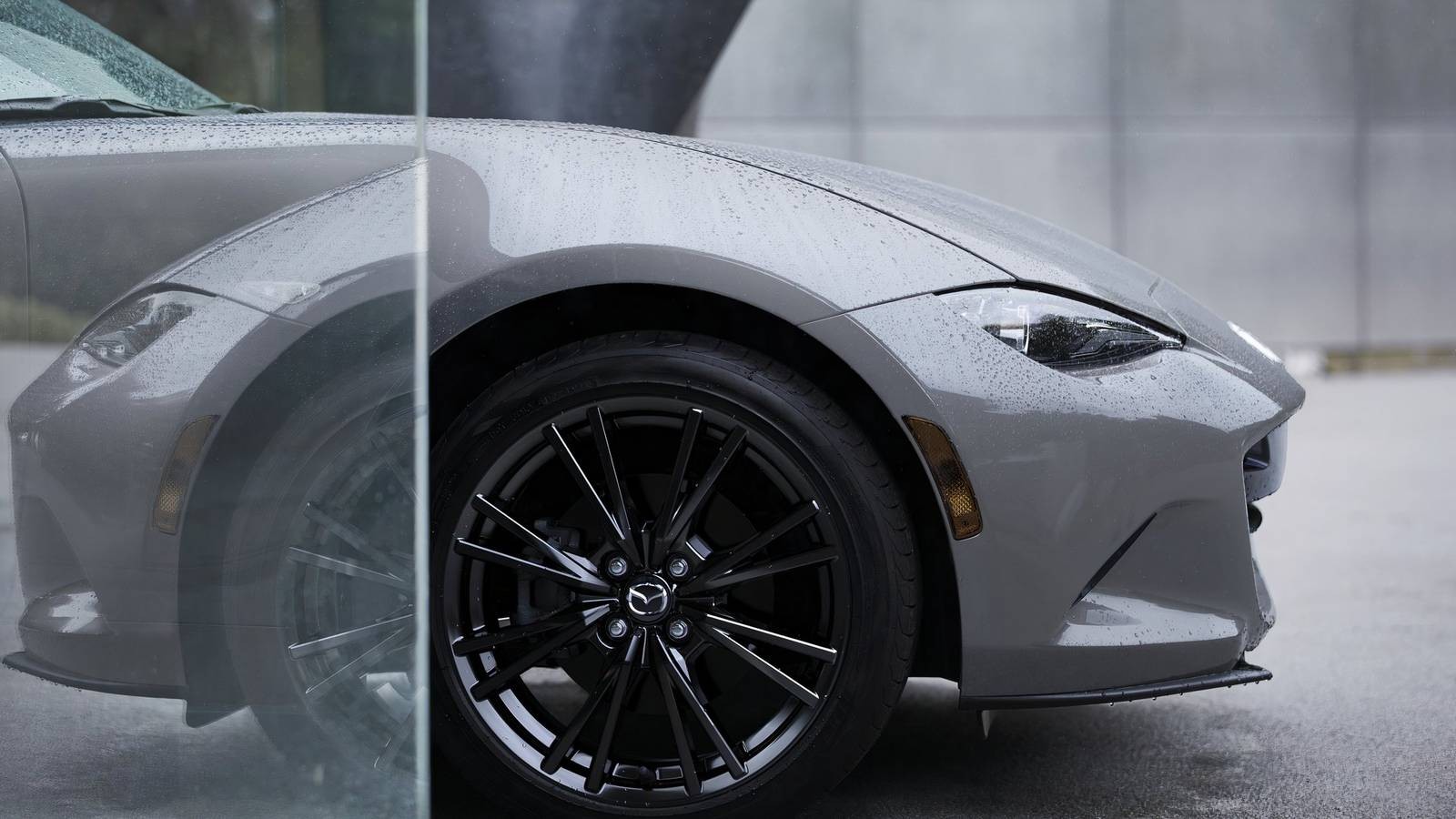
First introduced in 2014, the fourth-generation ND MX-5 has stood the test of time, earning the ‘World Car of the Year’ and ‘World Car Design of the Year’ awards in 2016. Incremental updates through a 2024 facelift have enhanced its aesthetics with LED lighting, revised bumpers, and new wheel designs.
The interior has also received subtle improvements: a redesigned gauge cluster, an 8.8-inch Mazda Connect infotainment system with wireless Apple CarPlay and Android Auto (excluding the base Sport trim), and increased use of premium materials. Handling has been further refined with an asymmetric limited-slip differential (LSD) for improved stability and Mazda’s Kinematic Posture Control (KPC) system to minimize body roll during cornering.
A Driving Experience Above Price Point
Beyond its reliability and design, the MX-5 excels in driving engagement. Its handling is deliberately tuned to provide feedback to the driver, mimicking the responsive connection between a rider and a horse. The steering is communicative, and the slick six-speed manual transmission adds to the tactile experience. While it’s not a modern machine, the MX-5’s joy of driving is unmatched even by higher-priced competitors. It’s an accessible driving experience; the degree of controlled body roll encourages enjoyment within legal speed limits.
The only major drawbacks are road noise and limited practicality, but these are trade-offs most enthusiasts accept willingly.
The Future of the Miata: Electrification on the Horizon
As the ND generation nears the end of its lifecycle, Mazda is exploring future powertrains for the next-generation “NE” Miata. Early prototypes suggest a mild-hybrid electrification option may be introduced. However, engineers acknowledge the challenges: batteries would significantly increase weight, altering the car’s balance and handling characteristics.
Mazda’s design director confirms that retaining the internal combustion engine is a priority, as it’s integral to the MX-5’s identity. Discussions of a larger 2.5-liter Skyactiv-Z engine have also emerged, although concerns about weight distribution remain. For now, the current ND generation will continue, with Mazda proceeding cautiously to ensure the next iteration retains the core spirit of the MX-5.
“We’re working ahead, but without making hasty decisions,” says a Mazda spokesperson. “What’s important is that we’re prepared when regulations or market conditions require it.”
The MX-5’s future remains uncertain, but one thing is clear: its enduring appeal lies in its simplicity, reliability, and pure driving enjoyment. It is a sports car that is built to last, both mechanically and in the hearts of its drivers.