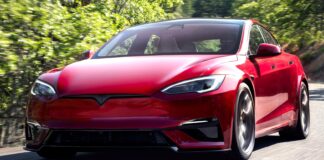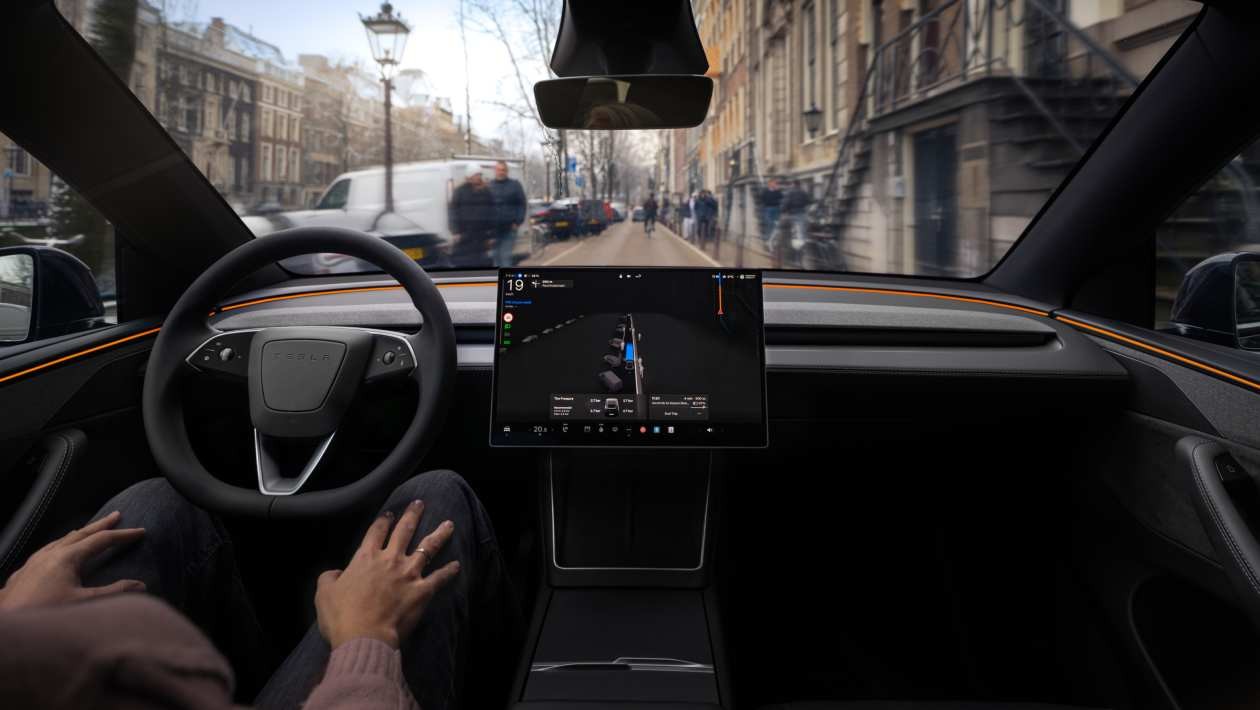
Tesla has reached a significant regulatory milestone in Europe. After nearly six years of development and deployment in other markets, the company’s Full Self-Driving (FSD) Supervised system has officially received approval for use in the Netherlands. This marks the first time the technology has been cleared for operation on European soil.
Зміст
Understanding the Technology
Despite its name, FSD is not a fully autonomous system. Tesla emphasizes that it is a supervised technology, meaning the driver must remain attentive and responsible for the vehicle at all times. The system manages steering, braking, and acceleration, allowing the car to navigate complex urban environments and react to traffic lights.
Unlike many of its competitors—such as Volvo, Mercedes-Benz, or various Chinese manufacturers who rely on LiDAR (light detection and ranging) sensors—Tesla utilizes a “vision-only” approach. The system processes data from external cameras and sensors through an onboard AI computer to interpret the surrounding environment.
Safety Claims and Real-World Data
Tesla maintains a high level of confidence in the system’s safety profile, citing several key metrics:
– Collision Reduction: Tesla claims that FSD Supervised makes collisions up to seven times less likely per kilometer compared to manual driving.
– Global Mileage: The company reports that users worldwide have already logged over 14 billion kilometers using the software.
– European Testing: Before seeking regulatory approval, Tesla engineers conducted extensive testing, covering more than 1.6 million kilometers on European roads.
The system continues to improve through a continuous learning loop. By using anonymized data from consenting customers, Tesla’s engineers can train the AI to recognize and react to rare, unpredictable driving scenarios.
The Regulatory Divide: Europe vs. the UK
While Dutch drivers will soon receive the software via an over-the-air update, the situation in the United Kingdom remains complicated.
Currently, UK customers can purchase “Full Self-Driving Capability” as an option for the Model 3 or Model Y, but the full suite of features is not yet legally permitted on British roads. Because the software has not yet been homologated (officially certified) for the UK, many of its most advanced features remain inactive.
The Cost Discrepancy: In the UK, customers can pay £6,800 for the FSD package, but without full regulatory approval, they are essentially paying for “Enhanced Autopilot.” This limited version—which handles motorway lane changes, overtaking, autoparking, and smart summon—is available as a separate option for £3,400.
Looking Ahead
The rollout in the Netherlands is just the beginning. Tesla has stated it is actively working with regulators across the continent to secure similar approvals in other European nations. For now, the expansion in the Netherlands serves as a critical test case for how vision-based AI handles the diverse driving cultures and infrastructure of the European Union.
Conclusion: Tesla’s regulatory breakthrough in the Netherlands marks a major step toward widespread semi-autonomous driving in Europe, though UK drivers face a significant wait and a pricing gap until local authorities grant official approval.