


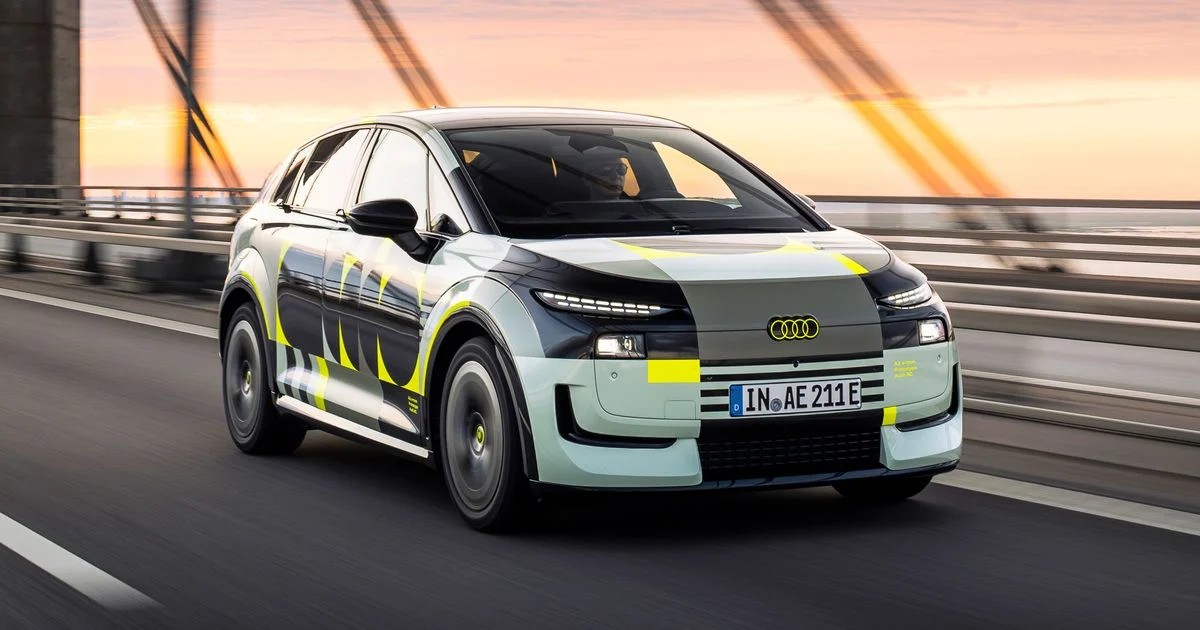
The nameplate is back. And no, it isn’t the boxy cult classic from the late 90s.
Audi is reviving the A2 name for 2027, but this time it’s strictly electric. The company has dropped fresh teasers—camouflaged prototypes, mostly—and the headline claim is aggressive: this will be the most efficient Audi to ever leave Ingolstadt.
That’s a heavy lift. Audi is known for premium, not necessarily for stripping energy down to the molecule. But they’re betting the farm on engineering finesse.
Зміст
The Battery and Efficiency Package
Let’s talk numbers. The range-topping model for efficiency won’t be the highest horsepower version. It’ll be the 140kW setup with the optional efficiency package.
Under the hood? A permanently excited synchronous motor. Audi built this specific unit for comfort and savings. It’s paired with a 61kWh gross Lithium Iron Phosphate (LFP) battery.
Why LFP? Two reasons: longevity and cost. These cells don’t need rare earth elements. They handle daily 100% charging without degrading as fast as nickel-cobalt alternatives. And they bond directly to the housing (cell-to-pack), which maximizes space without adding weight.
Audi claims an incredible 89.6% charging efficiency at a wallbox. That’s rare. It means less energy is lost as heat while you plug in. Preliminary WLTP tests show this specific configuration using just 12.8 kWh per 100 km.
Does that mean 470 km of range? Likely. Audi hasn’t confirmed the final WLTP figure yet. But do the math. It’s in the ballpark of the best-in-class.
Aerodynamics and Silicon Carbide
Efficiency isn’t just about batteries. It’s about pushing air out of the way.
The 2027 A2 e-tron boasts a drag coefficient (Cd) of 0.24. Best in the compact segment, Audi says. How did they get there?
- Front air curtains: They suppress turbulence before it hits the wheels.
- Gap reducers/breathers: These calm the air around the wheel arches.
- Active air intake: It opens and closes based on thermal needs.
- Underbody smoothing: Optimized to reduce drag.
These features alone shave off up to 0.9 kWh/100 km. That’s significant in a car that’s already efficient.
Inside the Motor
The 140kW motor uses new silicon carbide semiconductors. Silicon carbide switches faster and with less loss than traditional silicon. Audi says this cuts switching losses by up to 20 Watts just through variable frequency modulation. Another technique reduces those losses by 33%.
The stator laminations are thinner too—0.2mm versus the standard 0.3mm. Thinner layers mean lower iron losses. Combine that with a new low-friction transmission oil and a taller 10.2:1 gear ratio, and the motor spins slower at cruising speeds. Less speed, less resistance, more range.
Audi claims the motor is up to 10% more efficient than their existing equivalents. They aren’t exaggerating.
The MEB+ Platform Connection
The A2 e-tron rides on Volkswagen Group’s MEB architecture. Specifically, the rear-drive variant of MEB+. You know the platform from the ID.3, ID.4, ID.5, Cupra Born, and Skoda Enyaq.
It’s interesting because the closely related Volkswagen ID.3 Neo uses the same 140kW APP350 motor. The ID.3 Neo manages 13.9–14.9 kWh/100 km and up to 494 km range on a 58 kWh pack.
How does Audi beat VW with similar hardware? Optimization. By shaving 1.0 to 2.0 kWh/100 km off consumption through the aerodynamic package, the battery tech, and the motor tuning, Audi is squeezing more out of the same bones.
They’re not just assembling parts. They’re integrating them.
Will It Come to Australia?
The global debut is set for the autumn of 2026 (September–November). If the timeline holds, Australia gets the car in 2027.
Audi Australia isn’t hiding. An executive told CarExpert in May that the brand is “evaluating” the market for this compact EV. The logic is simple: the compact EV segment is growing fast. It’s where the volume is.
“There is a lot of growth in that segment,” the spokesperson said.
Audi isn’t just looking to sell cars. They’re looking to prove a point. That small electric cars don’t need to be compromises.
The A2 e-tron will try. If the efficiency numbers hold up in real-world testing, it might just work. If not, another badge will be retired before it really starts.
The wait ends soon.


