


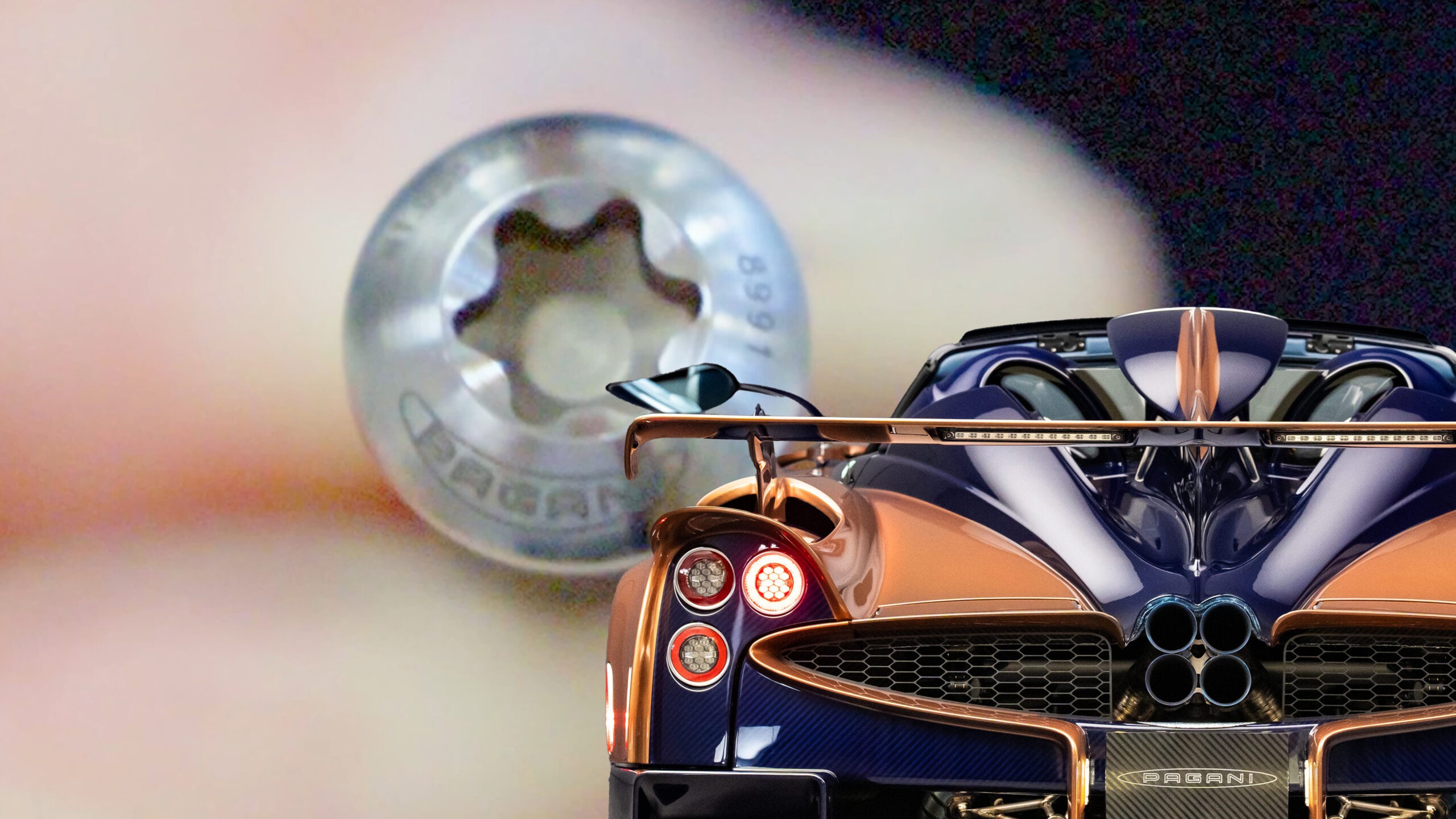
You’ve probably heard people call their rusted-out daily driver a “bucket of bolts.” It’s an insult. It means junk. It means low value.
Do that with a Pagani Zonda or Huayra and you’ll likely get laughed out of the room. Then, immediately after, you’ll get arrested for trespassing, because that bucket is worth more than your entire neighborhood.
Let’s put it in perspective. A brand-new Porsche 911 starts at $135,545 in the States. That’s a lot of money. It’s a fast, reliable, high-performance machine.
A single Pagani’s bolts alone cost about $161,308.
Yes, you read that right. The hardware that holds the supercar together is more expensive than a comparable vehicle from Stuttgart. How?
Titanium Fasteners: Why Pagani Bolts Cost $80 Each
The breakdown comes from a Carwow factory tour. Mat Watson walked through the San Cesario sul Panaro facility, and the details are borderline obscene.
Pagani doesn’t just bolt things down. They ascend things.
Each of the approximately 2,000 titanium fasteners used on a Pagani carries a tiny logo etched into its surface. And I don’t mean stamped. I mean laser-etched. The mark is two microns deep. That’s 0.002 millimeters. To give you a sense of scale, human hair is about 0.07 millimeters thick. The etching is 35 times thinner than your own scalp.
Watson showed the tool used for the engraving. It looked like something from a science fiction lab, not a car factory.
Here is the math that makes headlines:
- Cost per bolt: ~$80 (£60)
- Bolts per car: ~2,000
- Total fastener cost: ~$161,300
Note: Pagani doesn’t officially publish this line item. The figure is a calculated estimate based on unit cost multiplied by quantity. It represents the value of the components, whether purchased or hand-fabricated in-house.
But does that mean Pagani pays $160,000 just for screws? Or is this the aftermarket price? The video doesn’t clarify if this is production cost, retail value, or replacement pricing. We don’t need to know. The point isn’t the accounting. The point is the obsession.
Beyond the Bolts: When Every Component is Jewelry
The bolts are just the entry-level insanity. Once you accept that fasteners cost more than a Honda Civic, you start noticing other things.
Take the oil dipstick. In a normal car, it’s a bent piece of metal with a yellow handle. You pull it, wipe it, check the oil level. Done.
Pagani treats the dipstick like a piece of haute couture. It is milled from a solid block of titanium. Then it’s anodized. Then, before final installation, Pagani checks where it sits when tightened. They pull it out. They engrave the logo so it aligns perfectly straight. Then they put it back in.
Why?
Because it looks like jewelry. Because the car weighs less than some economy sedans thanks to the carbon-titanium weave, and every gram of material is justified by aesthetic perfection.
“It’s not just the bits staring at you. Everything looks like a sculpture.”
This isn’t hyperbole. Watch the steering wheel fabrication. It starts as a 95-pound (43 kg) block of aluminum. The CNC machines carve away 92 pounds of it. What remains? A 3.7-pound (1.7 kg) rim of raw metal.
Then comes the human element.
An 80-year-old craftsman spends eight hours polishing that wheel by hand. No robots. No automated polishing arms. Just an old man, a buffer, and a whole day dedicated to the tactile sensation of aluminum under a rag.
The $3.5 Million Question
A base Pagani costs around €3.1 million. That’s $3.58 million before you pick any options. Add a specific paint color? Add the titanium wheels? Add the carbon-ceramic brakes that cost more than your first house?
You are looking at a car where the fasteners are more


