


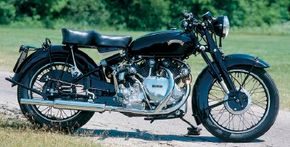
The 1951 Vincent HRD Series B Rapide looks wrong. Not broken wrong. Just structurally absurd.
You look at it and expect to see a tubular steel backbone. A cradle. Some kind of skeleton holding the engine and wheels together. There isn’t one.
The components are bolted directly to each other. It looks like a pile of parts held together by sheer willpower and high-tensile bolts.
This design wasn’t an accident. It was the result of one man’s obsession with efficiency and speed.
Philip Vincent started buying up motorcycle companies in 1928. He bought HRD that year. Added his name. Started building machines that were ahead of their time. And expensive.
Very expensive.
That expense eventually killed the company in 1955. But before the end, Vincent produced some of the most advanced motorcycles of the twentieth century.
Early Vincent bikes used J.A.P. engines. Standard practice for the era. But Vincent added rear suspension when everyone else was still running rigid frames.
Then came the innovation.
In 1935, Vincent built its own 500cc overhead-valve single. It worked. So they combined two of those singles on a common crankcase.
The result was the Series A 1000 V-twin.
It earned the nickname “plumber’s nightmare.”
Why? Because of the external oil lines. A spaghetti-like web of pipes ran all over the outside of the bike. It was messy. It was complex. It was brilliant.
World War II interrupted production. When it resumed, Vincent rethought everything.
Enter the Series B Rapide.
The 1951 model you see here isn’t just an update. It’s a structural revolution.
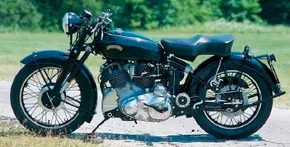
The new motor was a 50-degree V-twin. But it didn’t sit inside a frame. It was the frame.
The front and rear downtubes from older models vanished. The engine became a structural member of the chassis.
This is why the bike looks so odd.
There is no separate backbone. You are looking at a series of components bolted to a central powerplant.
The 1951 Vincent HRD Series B Rapide defies traditional motorcycle architecture.
This design had benefits beyond just saving weight. It made the bike incredibly rigid. And it changed how the bike handled.
But it didn’t stop there.
The front suspension used Girdraulic forks.
If you aren’t familiar with that term, don’t worry. It’s a mouthful for good reason.
It combined a girder-style front end with hydraulic shock absorption. It was unique to Vincent. No other manufacturer did it.
Rear suspension was just as weird.
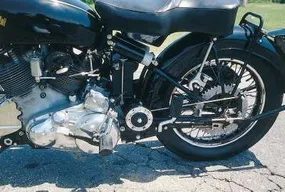
A triangulated swingarm compressed dual coil-over shocks. They sat beneath the seat. Not beside it. Beneath it.
This setup was advanced for the late 1940s. And it worked.
But speed was the point.
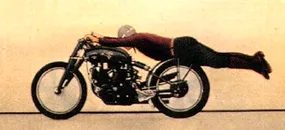
Vincents were the fastest production motorcycles of their day.
Their 1000cc engines displaced more than most European competitors. But they made power efficiently.
In 1949, Vincent dropped a higher-performance version into the lineup.
The Series C Black Shadow.
It had black-painted engine cases. A subtle nod to its extra power.
It was faster than the Rapide.
Today, the Black Shadow is one of the most coveted classic motorcycles in the world.
The Series B Rapide is its slightly more understated sibling.
It shares the same DNA. Same structural engine. Same advanced suspension.
But it lacks the black paint and the extra tuning.
That doesn’t make it less significant.
It makes it a study in engineering purity.
Philip Vincent wanted to build the best motorcycles money could buy.
He didn’t care if they looked strange.
He didn’t care if they were expensive to maintain.
He cared about the ride.
The 1951 model represents





Зміст
Why the 1951 Vincent HRD Series B Rapide Still Commands Respect
You cannot talk about the 1951 Vincent HRD Series B Rapide without acknowledging the premium tag. It was expensive. It was always expensive. Even in the post-war years when steel was scarce and optimism was fragile, Vincent demanded top dollar for its machines. But the quality matched the price tag. The construction was obsessive. Every bolt, every weld, every polished alloy surface screamed of an engineer who refused to cut corners.
Most motorcycles of that era were utilitarian. You rode them to work. You fixed them with a wrench and a prayer. The Vincent was different. It was a rolling statement of engineering superiority. The Series B Rapide wasn’t just a faster version of the previous model. It was a refinement of a concept that was already years ahead of its time.
Engineering the Impossible
The heart of the beast was the 998cc V-twin. It didn’t just breathe air. It devoured it. The overhead cam design was advanced. The cooling system was intricate. Jack Epstein and Phillip Vincent had built something that defied the limitations of 1950s metallurgy.
Speed was the goal. But stability was the prerequisite. The frame geometry of the Rapide was tuned for high-speed stability. You could hold 110 mph on the straightaways of the Continent. You could lean into corners with a confidence that most riders wouldn’t dare attempt. It wasn’t just fast. It was predictable at speed. That was the real trick.
The Cost of Perfection
The high price wasn’t a marketing gimmick. It was a reflection of the materials. The aluminum components were cast, not stamped. The engine cases were machined to tight tolerances. The paint was hand-sprayed. Every single unit was essentially a bespoke project. This is why finding one in original condition today is nearly impossible. They were ridden hard. They were crashed. They were rebuilt.
The Series B Rapide is often cited as one of the most beautiful motorcycles ever built. It’s not just about the curves. It’s about the function. Every line on the tank. Every curve of the fender. It all served a purpose. Aerodynamics were considered. Even in 1951.
Riding the Legend
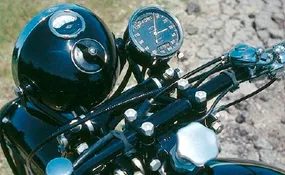
Holding the handlebars of a Series B Rapide is an experience in contrast. The controls are heavy. The engine response is instant. There is no lag. No hesitation. The power delivery is linear but aggressive. You don’t ride a Vincent. You negotiate with it. It demands respect. It demands attention.
For the enthusiast who knows the difference between a carburetor and a fuel injection system, the Vincent represents the pinnacle of mechanical purity. There are no sensors. No computer maps. Just air, fuel, and spark. Controlled by human hands. The 1951 model year is significant. It’s the culmination of the early Vincent design philosophy before the company’s finances began to crumble.
Preserving the History
Finding a 1951 Vincent HRD Series B Rapide today is like finding a needle in a haystack. A very expensive, heavy, and incredibly fast needle. Restorations are meticulous. Original parts are rare. The value is astronomical. But for those who own one, the price is irrelevant.


