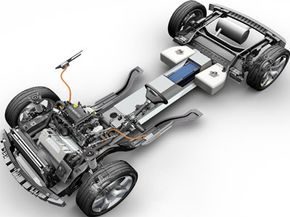
The Ghost of EV-1 Past.
In 1996, General Motors dropped the EV-1 into Saturn showrooms across California and Arizona. It was pure electricity. Zero emissions. Zero gas. For seven years, over 1,000 of these sleek sedans were leased to early adopters who wanted to escape the pump. Then GM pulled the plug. The consensus? Consumer demand was weak. Battery tech was primitive. Most of the fleet didn’t end up in driveways. They ended up in crusher bins.
Fast forward to the late 2000s.
Gas prices have spiked. Battery density has improved. And GM is back in the game. But they aren’t repeating history. They’re changing the rules entirely with the E-Flex Propulsion System. This platform underpins the Chevrolet Volt, a plug-in hybrid electric vehicle (PHEV) slated for showrooms by the end of 2010.
Зміст
How E-Flex Differs from Traditional Hybrids
Most people confuse the Volt with a standard hybrid like the Toyota Prius. They aren’t the same. The distinction matters.
With a standard hybrid, the internal combustion engine (ICE) is mechanically linked to the wheels. It helps push the car, especially during acceleration. Without the gas engine, the electric motor can’t do the heavy lifting. It’s a partnership.
“Our engine is not directly connected to the wheels and only comes on when the battery is depleted,” said GM spokesman Dave Darovitz.
GM engineers call the Volt’s setup a “revolutionary spin.” The wheels are driven solely by electric power. Always. Even when the gas engine is running.
Here’s the trick. The gasoline engine acts as a range extender. It’s a stationary on-board generator. Once the battery pack empties, the ICE spins up. It doesn’t drive the car. It generates electricity to recharge the battery, which then powers the electric motor. No mechanical link. No clutch. Just pure electric propulsion, backed by a gas-fired generator.
The 40-Mile Rule
Why does this setup matter for your daily commute?
After plugging into any standard household outlet overnight, the Volt offers up to 40 miles (64 kilometers) of all-electric range. That’s enough for most daily commutes. You burn no gas. You pay for electricity.
Once those 40 miles are gone, the range extender kicks in. The car continues moving on electric power. The battery maintains a charge. You never feel a shift in power delivery because the drivetrain never changes. It’s just an electric car with an endless supply of electricity.
But what’s powering that battery? And how much will this actually cost you compared to a gas guzzler?
The E-Flex Battery
We need to look under the hood. Specifically, at the heart of the E-Flex platform.
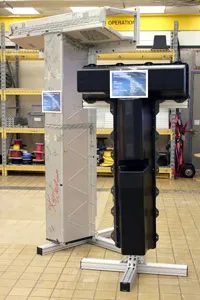

The Battery: Heavy Lifting, Low Profile
We are talking about a 400-pound chunk of lithium-ion chemistry here. 181 kilograms of pure energy density. It generates up to 16 kilowatt-hours of electricity. That is the heart of the E-Flex system.
Why does this matter? Because previous attempts at electric vehicles were bloated. Take the GM EV-1. It used a lead-acid pack. The power output was roughly similar to what E-Flex delivers today, but the weight? The EV-1 battery weighed in at about 2,200 pounds. That is nearly a ton more dead weight.
The geometry of the cells makes the difference. Most EVs of that era used cylindrical lithium-ion cells. E-Flex goes flat. Flat cells take up less spatial volume. You pack more energy into the same footprint. Cooling becomes trivial too. Fluid flows across a flat surface without fighting turbulence.
It is not just a component. It is structural.
The battery is too large for an engine bay. It is built into the chassis. A T-shaped rail runs from front to rear axle. The top of the T sits under the rear passenger seat. This placement protects the pack in a collision. It also drops the center of gravity.
Tony Posawatz, who later directed the Chevrolet Volt line, put it bluntly: “The heart and soul of [the E-Flex platform] is the battery, with a vehicle on top.”
Engineers know how to bolt on an engine. They know how to fit a transmission. But integrating a massive battery pack? Managing the heating, the cooling, the exotic materials? That was uncharted territory.
Hydrogen fuel cells? That is a future problem. Infrastructure is missing. Electric charging? The grid is already there. Posawatz noted the math clearly: electricity runs one or two cents per mile. Gas sits at ten cents. The economics work without waiting for new pipelines.
Driving Dynamics and Charging
The E-Flex battery feeds an electric motor. This motor drives the front wheels. Silence is the first thing you notice. No combustion noise. Just tire roar.
Output sits around 120 kilowatts. That converts to roughly 160 horsepower. Numbers sound modest until you remember how electric motors behave. Internal combustion engines need to rev to hit torque peaks. Electric motors deliver instant torque. Zero to 60 mph happens in under 9 seconds.
It does not feel like an economy car. It feels like a V-6 sports sedan launching from a stoplight. The acceleration is immediate. Unrelenting.
Regenerative braking plays a huge role here. When you lift off the gas or tap the brake, the motor reverses function. It becomes a generator. It captures kinetic energy. It feeds that energy back into the battery. The low mounting position of the battery aids handling stability during these high-G maneuvers.
Charging is mundane. It uses the same lithium-ion chemistry as your laptop or phone. Just scaled up.
Plug into a standard 110-volt household outlet. Any kitchen socket works. GM expects most users will charge overnight in their garages. That takes about six hours. If you have a 220-volt circuit, cut that time in half. Three to four hours.
Andrew Farah, the Volt’s chief engineer, wanted to demystify the process. The components are complex. The experience is not. Keeping the car running is as simple as plugging in a lamp. There is a plug on the side of the car. You plug it into the wall. That is it.
The E-Flex Range Extender
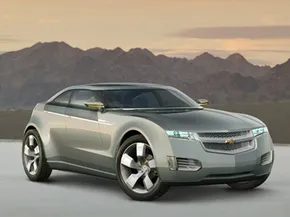

The moment that initial battery charge dips, the range extender takes over. GM calls it that, but functionally, it’s just an internal combustion engine sitting in the front of the vehicle. In the Chevrolet Volt concept, it’s a 1.0-liter, three-cylinder engine. It doesn’t drive the wheels directly. It spins a generator to keep the battery topped up. The fuel tank holds 12 gallons.
Engineer Andrew Farah puts it plainly. Most electric vehicles are simple. Battery. Motor. That’s it. Run out of charge? You’re pushing. On the E-Flex platform, that doesn’t happen. The gasoline motor eliminates the “range anxiety” that makes drivers stare at gauges, calculating if they have enough juice to make it home.
You still need gas. The car runs up to 40 miles on battery power alone. After that? The gas motor engages. It’s not optional if you want to keep moving.
GM’s pitch is aggressive. They claim the average driver saves 500 gallons of fuel a year. Almost no gas station visits. No typical engine service schedules. They want you plugging in as much as possible to keep the battery conditioned.
Fuel Flexibility and Hydrogen Plans
Engineers are already looking beyond just gasoline. The goal is a range extender that runs on gasoline or E85 ethanol blends. In Europe, they’re testing diesel. There’s also a hydrogen fuel cell variant in development.
“You’d be running the fuel cell most of the time, and the battery not as much.”
In that configuration, you remove the range extender and generator entirely. Hydrogen cells take their place. The battery plays a secondary role. It’s a different architecture, but the E-Flex philosophy remains.
Zero Emissions for the Daily Commute
GM wants these cars to be clean. Really clean. For the first 40 miles of driving, emissions are zero. The electric motor puts out no chemicals. No pollutants. No exhaust.
Once the engine kicks in, efficiency jumps. GM engineers estimate about 50 miles per gallon with the range extender active. The concept car promised over 600 miles of range. The production version offers about 360 miles. Why the drop? Smaller gas tank. Less weight.
GM officials argue the reduction makes sense. Darovitz asked why anyone would carry fuel they might never use. Most Americans don’t drive over 400 miles without stopping. In fact, GM estimates that more than 75 percent of U.S. commuters drive less than 40 miles a day.
If the E-Flex vehicles hit their targets, those commuters never use a drop of gasoline. No harmful emissions during the daily grind. The smaller tank might ironically boost overall fuel economy numbers, even if you rarely tap into it. But if you decide to hit the highway? You still get that 50 mpg.
So when can you actually buy the Chevy Volt? And what else is on the E-Flex roadmap? The next chapter holds the pricing and availability details.
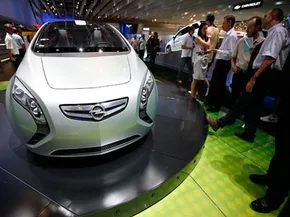
The E-Flex Platform and the Volt’s Ambitious Roadmap
The Chevrolet Volt arrived at the 2007 North American International Auto Show (NAIAS) as the flagship of GM’s new E-Flex platform. It wasn’t the EV-1. That was a two-seat, two-door oddity. This was a four-door compact sedan. Four seats. The cabin could fit a 6-foot-2-inch guy in the back. No center seat though. That space went to the battery pack in the floor. Keeping the roof low helped airflow. Aerodynamics weren’t optional. GM needed that fuel economy to work.
Getting there was the hard part. The timeline for the Chevrolet Volt was brutal. Engineers wanted the cars on the road by late 2010. That meant massive testing. The battery had to stay cool. It had to be safe. It had to survive bumpy roads. And it had to be mass-producible. You can’t just hand-build a prototype and hope for the best when you’re aiming for volume.
Pricing was another headache. GM initially floated $30,000. Then the talks got fuzzy. Darovitz, a GM spokesman, put it bluntly.
“Pricing of the Chevrolet Volt has not yet been determined.”
They were looking at government tax credits. Customer benefits. Subsidies. Electricity cost versus gasoline savings. Initial volumes. The price would be linked to gas prices at launch. Makes sense. If gas is $5 a gallon, the value proposition changes.
Beyond the Sedan: Opel Flextreme and Cadillac Provoq
Months after the Volt reveal, GM rolled out the Opel Flextreme. It’s the European cousin. A stylish five-door hatchback. Same heart. The same E-Flex tech. But the range extender was different. A 1.3-liter turbo-diesel engine. Not an internal combustion gas engine. Diesel powered most cars in Germany. Opel’s home turf. This made the Flextreme better suited for European roads.
Then came the Cadillac Provoq. Hit the show circuit in January 2008. An SUV. But it used an E-Flex system paired with hydrogen fuel cells. No tailpipe emissions. Just water vapor.
The numbers were impressive. 280 miles on hydrogen. 20 miles on electric battery energy. All while producing zero harmful emissions.
These were still concepts. But Farah, the chief engineer, said the components were designed for a wide range of vehicles.
“We should be able to broaden the availability of this kind of technology, to put it in all kinds of different cars people want.”
How It Fits Together
The E-Flex platform wasn’t just about one car. It was a modular approach to propulsion. Whether it was a compact sedan, a European hatchback, or a hydrogen SUV, the underlying philosophy remained the same. Electrification with a backup range extender.
For the Volt specifically, the engineering challenges were immense. Battery thermal management. Safety under stress. Aerodynamic efficiency. All of this had to converge before the production run started. The price tag was still up in the air, tied to market conditions and subsidies. But the tech was real. And it was coming.
Whether the $30,000 price point ever held up is another story. The timeline was ambitious. Some called it impossible. But the pieces were there. The battery. The motor. The aerodynamics. The platform.
What happens when the subsidies dry up? Or when gas prices drop? The math changes. The Volt was built for a specific moment in time. A moment where electricity and gasoline were at war. And GM wanted to be the peacekeeper. Or the victor. Depends on how you look at it.