Wind whipping past your ears. Sun on your skin. That raw connection between driver and road is the holy grail of open-air driving. But getting there requires a mechanical dance that defies basic physics. A convertible isn’t just a coupe with the roof cut off. It has to be strong enough to handle torsion. It has to be quiet. And the roof needs to fold away without ruining the car’s shape.
Designers face a brutal puzzle. You are removing structural rigidity from a vehicle that relies on stiffness for handling and safety. The result? Complex engineering to keep the chassis from twisting like a wet noodle.
Зміст
The Structural Challenge
When you remove a fixed roof, you remove the car’s backbone. A hard-top coupe acts like a beam, resisting twisting forces. Strip that away, and the body flexes. This flex affects handling precision. It creates squeaks. It weakens crash safety.
Engineers solve this by adding braces. They reinforce the firewall. They stiffen the sills. Sometimes they add a rear bulkhead. The goal is simple: mimic the rigidity of a fixed roof using as little extra weight as possible.
“The roof isn’t just weather protection. It’s a structural component.”
Soft Tops: Cloth and Vinyl
The classic soft top uses layers of vinyl or fabric. Underneath lies a steel or aluminum frame. The mechanism folds this frame into the trunk or behind the rear seats.
Pros:
– Lightweight.
– Cheaper to manufacture.
– Easier to repair if torn.
Cons:
– Poor insulation. You hear more road noise.
– Less secure against break-ins.
– Degrades faster in UV light.
Modern soft tops are better than those from the 90s. They use multi-layer fabrics with noise-canceling properties. But they still lack the solidity of metal.
Retractable Hardtops: The Engineering Marvel
Here is where it gets interesting. A retractable hardtop (RHT) gives you the look and rigidity of a coupe with the versatility of a convertible. But the machinery required to move a heavy metal roof is complex.
The most common design uses a three-piece folding system. One piece stays fixed over the cabin. Two other pieces fold down behind the rear seats or in the trunk. This requires a massive storage space. You often lose trunk capacity.
Key Components:
– Hydraulic actuators: They provide the force to lift the heavy metal.
– Complex linkages: These guide the panels into precise positions.
– Seals and latches: They must be robust to prevent leaks and wind noise.
The process takes time. Most RHT systems take about 20 seconds to open or close. You sit there, listening to the whir of motors and the clunk of metal. It’s slow. But the result is a cabin that feels solid.
Why Choose a Retractable Hardtop?
Drivers choose RHTs for two main reasons. First, noise reduction. Metal blocks sound better than cloth. Second, security. A hard top is harder to break into.
But there is a trade-off. Weight. An RHT system adds several hundred pounds to the vehicle. This affects acceleration and fuel economy. The added complexity also means


Stripping the roof off a sedan doesn’t make a convertible. It makes a structural liability. You might think folding metal is just about mechanics, but the physics of torsional stiffness change everything. A hardtop acts as a shear panel. It resists twisting. Remove it, and the chassis is suddenly a hollow tube.
To fix this, engineers have to weld in heavy brackets. They reinforce the floor pans. They stiffen the door sills. The result? Convertibles are almost always heavier than their coupe siblings. If you skipped these steps, the body would flex under load. Drive over a speed bump at an angle, and the frame twists. You’d hear every rattle in the interior within months. Handling would degrade. The car would feel loose. So, we add weight to keep it tight.
Aerodynamic Penalties and Fixes
Drag is the enemy of efficiency. A coupe’s roof creates a smooth, laminar flow. Air glides over it and exits cleanly. A convertible with the top down breaks that flow. The air hits the windshield, separates, and creates turbulence.
Inside the cabin, the physics get worse. Fast-moving air outside meets the stagnant air inside. That boundary layer destabilizes. You get vortexes. Think of them as horizontal tornadoes spinning in the rear deck. They pump air forward into the passenger compartment. Your hair blows back. The cabin noise spikes. Drag increases.
The fix is simple: a glass wind deflector. It sits behind the headrests. It blocks the vortex. The air flows around the deflector instead of churning inside. Quiet cabin. Lower drag. Better comfort.
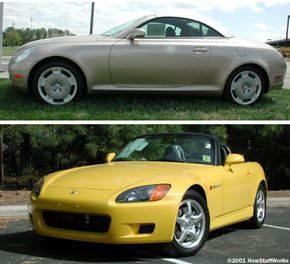
Some manufacturers go further. The Lexus SC430 is a prime example. Its aerodynamics with the top down are nearly identical to the top-up configuration. How? Complex underbody shielding and precise roof geometry. We’ll dissect that engineering later. First, let’s look at the traditional soft top.
Soft Top

Manual Latches, Automated Lift
The Honda S2000 roadster roof is pretty standard for a drop-top. You get a power motor, but you still have to manually handle the latches at the windshield. It’s a hybrid approach. You flip switches on the dash to do the heavy lifting, but you’re the one who has to actually unlatch the glass.
To drop it, you start by releasing those latches. Then you hit the switch on the dashboard and hold it in the open position. If your windows are up, they’ll automatically roll down first. Don’t worry about forgetting. The roof won’t move until the glass is out of the way.
The motion of the roof and the positioning of its different parts is completely determined by the geometry of the roof structure.
Once the windows are down, the roof folds itself into the compartment behind the seats. It’s tidy. No loose canvas flapping in the wind.
How the Honda S2000 Convertible Roof Mechanism Works
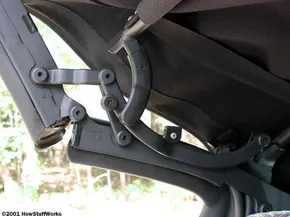
Under the hood, or rather under the rear deck, is a motor that turns a gear on each side of the car. This is what powers the entire process. The gear engages a bracket with teeth cut into it. Think of it like the mechanism in a power window. Just more complex. More exposed.
That bracket connects directly to the main structure of the roof. As the gear spins, it pushes or pulls that structure. It moves the roof into the exact position needed to be either up or down.
But the motor doesn’t do all the thinking. The geometry does. A scissors-like linkage made of metal arms and brackets forms the skeleton. Pins link everything together. When the roof is up, those arms expand to create a rigid structure. When it goes down, the linkage folds into itself. It tucks away neatly.
It’s not just a blanket dropping down. It’s a mechanical puzzle that solves itself every time you press that switch. The shape dictates the movement. The geometry ensures it fits. No guessing. No jamming. Just precise engineering doing its thing.
Why bother with manual latches if the rest is automatic? Probably to save weight. Or maybe for that tactile connection. You feel the click. You hear the clunk. It’s not just a button press. It’s a ritual. And for a car this focused, rituals matter.
The Geometry of Folding
The linkage is the key. Those metal arms don’t just swing around randomly. They follow a specific path. Defined by pins. Defined by brackets.
When the roof is closed, the structure is locked tight. The geometry holds it in place against wind and rain. When you want it open, the gears reverse. The arms fold. The roof collapses.
It’s simple in concept. Complex in execution. The S2000 doesn’t have a complicated array of sensors and motors for every tiny movement. It relies on the shape of the metal itself. If you built the linkage right, the roof will always end up in the right spot.
That’s the beauty of it. You don’t need a computer to tell the roof where to go. The physics does the work. The motor just provides the force. The rest is geometry.
And that’s why the S2000’s top feels so solid when it’s up. It’s not just fabric over a frame


Once the roof folds down, clips engage to clamp it securely against the windshield frame. This seals any air gaps that might cause wind noise or leaks.
Take the Honda S2000 for instance. It uses a soft top with a rear window made of clear, flexible plastic. That plastic window actually folds as the roof retracts, making the package more compact.
Some larger convertibles skip this trick. They use rigid glass rear windows instead. These can’t fold, which often means a bulkier storage profile. Some of these harder tops even include defrosters to keep the view clear when the weather turns.
But there is another option. One that offers the stiffness of a coupe with the open-air freedom of a convertible.
The Rise of Retractable Hardtops
We are moving on to a different beast. The retractable hardtop.
This design solves a major flaw in traditional convertibles. Soft tops are light. They are also flimsy. You get wind buffeting. You get noise. The roof lacks structural rigidity, which hurts handling.
A retractable hardtop gives you a steel or aluminum roof. It stacks away when you want sun. It locks down when you want silence.
“The goal is a roof that feels as solid as a coupe when up, yet disappears completely when you want it gone.”
Manufacturers like BMW, Mercedes-Benz, and Chrysler pioneered this. They use complex linkages and motors. The roof panels fold and tuck into the trunk or a dedicated compartment.
It adds weight. It adds cost. But for many buyers, the trade-off is worth it. You get the best of both worlds. Or at least, you try to.
The Engineering Challenge
Building one of these machines is not simple.
The roof needs to be strong enough to brace the chassis. It needs to be light enough not to overwhelm the suspension. It needs to seal tightly against rain and wind. And it needs to fold into a finite space.
Engineers use a series of hinges and pistons. Electric motors drive the movement. Sensors monitor the position. If something jams, the system stops.
The rear window is often a separate piece. It might be glass or plastic. It folds separately or stays fixed while the main roof panels move.
Chrysler’s PT Cruiser Cabriolet is a prime example. It uses a multi-layered design. The trunk lid lifts up. The roof panels fold underneath. It’s a clever solution to a tricky problem.
BMW’s 6 Series and 3 Series also use this tech. They call it a “soft top with a hardtop feel” or a full retractable hardtop. The engineering varies, but the goal is the same.
Real-World Implications
Weight is the enemy here.
A retractable hardtop can add hundreds of pounds to the car. This affects acceleration. It hurts braking distances. It changes the handling balance.
Fuel economy takes a hit too. The aerodynamics are worse with the roof up compared to a fixed metal roof. The mechanism adds drag.
But the driving experience is superior. No more canvas sagging in the heat. No more plastic windows crackling in the wind. Just solid steel or aluminum above your head.
The noise levels drop significantly. The ride quality improves because

The Lexus SC430 operates on a completely different philosophy than soft-top rivals. This is a hardtop convertible that refuses to compromise on structural rigidity or cabin silence. It delivers the quiet, stiff chassis of a coupe until a single button press transforms it into an open-air cruiser. No latches to fiddle with. No manual cranking. Just push and go.
The engineering behind this transformation is surprisingly efficient. The roof folds in half and stows directly into the trunk. The sequence is automated and precise: press the button, and the system handles the rest. Windows roll down, and the trunk lid swings upward. This isn’t a standard trunk opening; it lifts from the rear, hinging at the front of the compartment closest to the windshield. Once the lid is up, the roof mechanism engages.
The hardtop halves fold backward, nesting into the space above the trunk floor. When fully stowed, the trunk lid closes, sealing the mechanism away from the elements. Intriguingly, the trunk remains functional even with the roof down. You can still load groceries or luggage, though cargo space is significantly compromised by the folded roof panels occupying the majority of the well.
The Mechanics Behind the Lift
Making a fully automatic hardtop work requires a network of motors, actuators, and sensors. The primary roof motors share design DNA with those found in the Honda S2000, providing the necessary torque for deployment. However, the Lexus adds complexity. It needs extra motors to manage the trunk lid and the locking mechanisms for the roof panels.
Despite the added hardware, the folding linkage is simpler than some competitors. Because the SC430 roof only requires a single fold in half, it avoids the intricate multi-stage folding sequences seen in more complex retractable hardtops. This simplicity reduces potential failure points.
Is a Hardtop Convertible Worth It?
Owning a convertible like the SC430 is akin to having two cars in one bay. With the top up, it serves as a practical daily driver, offering coupe-like utility. With the top down, it becomes a weekend toy. The transition is so seamless that the barrier between “practical” and “fun” disappears.
Convertible Car FAQs
What defines a convertible car?
A convertible is a vehicle designed to transition from a covered configuration to an open-top layout. The roof retracts or folds away, exposing the cabin to the elements.
Are convertibles limited to two doors?
No. While two-door models dominate the market, four-door convertibles exist, offering greater accessibility and passenger space.
Why might you avoid buying a convertible?
There are tangible drawbacks. Convertibles typically sacrifice cargo volume and rear seating space. Visibility can be impaired when the top is up due to thicker pillars and rear deck structures. They are less suitable for harsh climates and can be targets for theft due to the value of their specialized components.
Did Dodge ever make a Challenger convertible?
Dodge never offered an official Challenger convertible from the factory. However, aftermarket specialists and some dealerships have created custom conversions for enthusiasts seeking that specific aesthetic.
Does Mercedes-Benz produce a hardtop convertible?
Yes. Mercedes-Benz produced the SLC Roadster (formerly the SLK), which featured a fully automatic hardtop convertible system, similar in concept to the Lexus approach.
Related Articles
- How Car Engines Work
- How Gears Work
- How Motors Work
- How Car Computers Work
- How Sunburns and Sun Tans Work
- How do retractable roofs in stadiums work?
Further Reading
- Patent: US4799727: Folding automobile convertible top and rear window assembly having a flexible hinge
- Patent: US5375901: Convertible top with fold-down rear window
- Convertible Top Frames and Introduction
- The history of the convertible
- Collins & Aikman Convertible Top Systems