
Fuel prices are climbing at the pump. New car buyers are vanishing from showrooms. New car registrations have been sliding for over a year. In June 2022, only around 170,000 cars were registered compared to nearly 200,000 in June 2021. That is a drop of almost 15%. Only electric vehicles are pulling their weight.
How do hydrogen cars actually work?
A hydrogen car is an electric car. It just gets its power differently. Standard electric vehicles store electricity directly in a battery. Hydrogen vehicles use fuel cells. These cells convert hydrogen into electricity. The process also produces heat and water as byproducts.
Hydrogen car registrations remain niche in France. Will low fuel prices finally boost sales?
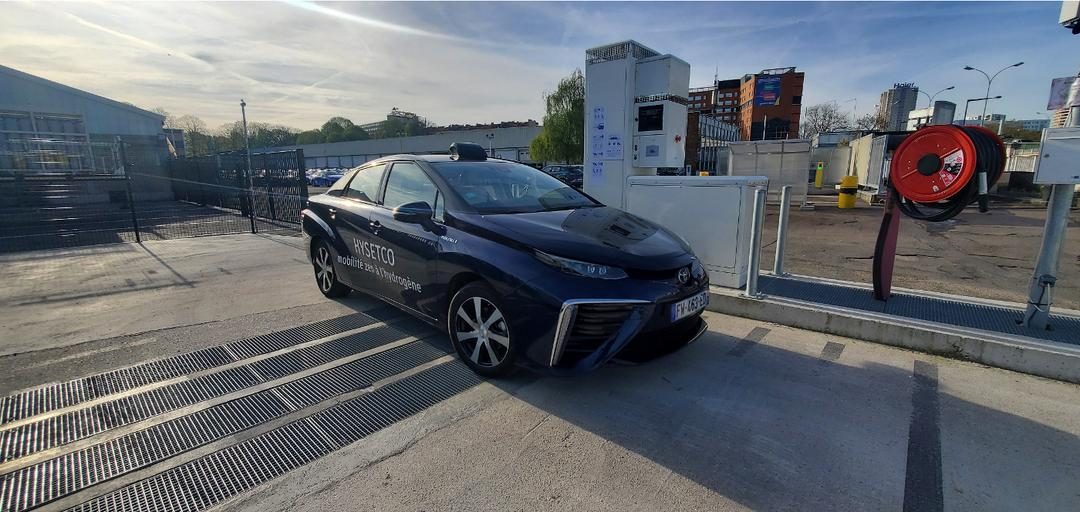
“Today, we can offer a tank fill-up for 75 euros,” says Camille-Léa Passerin. She is the development director at HYSETCO. This French startup is one of Europe’s leaders in hydrogen mobility. A 75-euro fill-up sounds almost dreamlike. But what does a hydrogen tank actually hold?
“A taxi consumes about 1.2 kilograms of hydrogen per 100 kilometers,” Passerin explains. “With a 5 to 6-kilogram tank, you get a real-world range of about 500 kilometers.”
Why focus on taxis first?
Passerin mentions taxis because that is the use case she knows best. HYSETCO built a turnkey service for professional drivers. They provide hydrogen distribution stations. They also maintain and lease a fleet of vehicles to these clients.
“Hydrogen is particularly well-suited for intensive use,” Passerin notes. “It serves professionals who need good autonomy and cannot afford to wait thirty minutes for a battery to charge.”
The experience at a hydrogen pump mirrors filling up with gasoline. The tank fills in under five minutes. No waiting. No charging cables. Just fuel.
This model works for high-mileage drivers. It also works for those who want range without the range anxiety of early EVs. As gas prices stay high, the math is becoming clearer. The infrastructure is growing. The technology is proven. The question is just whether consumers will switch from batteries to tanks.
The Hydrogen Price Gap: Why It Still Feels Artificial
Convincing buyers isn’t just about the tech. It’s about the grid. You need stations. You need them on your route. If they aren’t there, you won’t buy the car.
Camille-Léa Passerin puts it bluntly. Early taxi drivers adopted hydrogen only because they actually found a station on their daily path. Today, HYSETCO runs four stations in Paris. They push about 7 tons of hydrogen monthly. That serves roughly 200 taxis. The goal? Twelve stations by 2024. Thousands of vehicles behind that.
Right now, the selection is painfully small. Passerin admits it. You have the Toyota Mirai sedan. The Hyundai Nexo SUV. That’s it. Two cars. But the utility sector is shifting. Vans and trucks are entering the chat. Hydrogen has a distinct advantage there. Electric batteries add weight. Hydrogen tanks don’t. You keep your payload. The fuel doesn’t weigh down the truck like a giant lithium pack does.
For the average buyer? Battery electric vehicles still win. They are cheaper to buy today. They will stay cheaper. Until two things happen. First, more hydrogen cars hit the market. Second, the station network actually expands. And finally, industrialization scales up. That’s when acquisition costs drop. The sector still needs subsidies. Regulations are forcing alternatives to combustion engines. Industrialization will follow. Costs will fall.
Look at the Toyota Mirai 2. It costs nearly 15% less than the first generation. The trend is moving down.
Then there’s the fuel. The price at the pump is… weird. It feels artificial. Why? Because we are being subsidized. And because we can’t yet distribute enough green hydrogen. Passerin acknowledges the gap. Right now, a full tank runs 75 euros. That breaks down to roughly 15 euros per kilogram. The target set by ADEME is 9 euros per kilogram. If we hit that? A full tank drops to 45 euros.
Not bad. But not yet reality.