The annual summer gasoline price hike is a ritual we all dread. It arrives with predictable brutality. For a quick reminder of why this is a problem, look at the summer of 2008. The average nationwide price for a gallon of regular gasoline climbed past the four-dollar mark. Filling up a tank wasn’t just an errand. It was a financial gamble. You had to check your bank balance before you even inserted the nozzle.
Those memories are still sharp. So when the pump prices start creeping up again, the question naturally arises. What else is there?
The answer is a crowded field of options. Many of these alternative fuels are available today. They are in dealerships. They are on highways. Some technologies need more time to scale up for mass adoption. Others are ready for you to buy this weekend. Here are the top contenders.
Зміст
10: Hydrogen Fuel Cell Vehicles
Hydrogen might seem like science fiction to some. In reality, it is one of the most established alternative fuels for passenger cars. The concept is simple enough. You take hydrogen gas. You combine it with oxygen from the air. The chemical reaction produces electricity. That electricity turns an electric motor. The only emission is water vapor.
“The only emission is water vapor.”
This process happens inside a fuel cell stack. It doesn’t burn fuel in the traditional sense. There is no combustion. This makes hydrogen fuel cell electric vehicles (FCEVs) unique. They offer the long range and quick refueling times of a gas car. They also provide the smooth, instant torque of a battery electric vehicle (BEV).
Toyota and Honda have been pushing this technology for years. The Toyota Mirai and the Honda Clarity Fuel Cell are two of the few mass-market options. They look like sedans. They drive like sedans. But they require a different infrastructure.
Finding a hydrogen station is the main hurdle. These stations are not everywhere. They are clustered in specific regions, primarily California. If you live in Southern California, you might have access. If you live in Ohio, you probably don’t. The scarcity of stations limits widespread adoption.
The cars themselves are expensive. Production costs remain high. Battery electric vehicles have benefited from massive economies of scale. Hydrogen vehicles have not reached that tipping point yet.
Still, the technology works. It is clean. It is fast. Refueling takes about three to five minutes. That is comparable to filling a gas tank. The range is competitive too. The Mirai gets roughly 400 miles on a full tank. That beats most current EVs in cold weather conditions. Batteries lose efficiency in the cold. Hydrogen fuel cells do not.
There are concerns about the source of the hydrogen. Most hydrogen produced today comes from natural gas. This process releases carbon dioxide. It is not “green” unless you use renewable energy to split water molecules. This is called “green hydrogen.” It is expensive. It is rare. But the industry is investing heavily in it.
If you can find a station and can afford the premium price, hydrogen offers a compelling middle ground. It solves the range anxiety that plagues early EV adopters. It avoids the long charging times that frustrate road trippers. It just needs a better network to survive.
The summer of
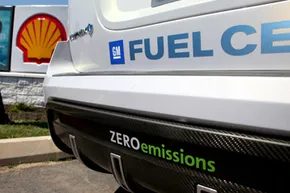

Hydrogen makes people think of the Hindenburg. It’s a reflex. But in practice? It’s surprisingly safe. The technology splits into two distinct paths for getting a car moving. You have fuel cell electric vehicles (FCEVs) and hydrogen internal combustion engines (H2-ICE). They sound similar. They aren’t.
How Fuel Cell Vehicles Actually Work
A fuel cell vehicle doesn’t run on a battery pack like a Tesla or a Leaf. It generates its own electricity on the fly. You have hydrogen tanks. You have oxygen from the air. Inside the fuel cell, they meet in a chemical reaction. The result is electricity. That electricity spins electric motors.
The only exhaust? Water vapor. That’s it. No tailpipe emissions. No CO2. The Honda FCX Clarity is the poster child for this. It uses this exact tech. Right now, Honda is leasing these units to drivers in southern California. It’s a controlled rollout. You can’t just go buy one today if you live in Ohio.
The Combustion Alternative
Then there’s the other way. A hydrogen internal combustion engine. This looks like a gasoline engine under the hood. It has pistons. It has valves. It burns hydrogen instead of gas.
Again, the byproduct is water vapor. The BMW Hydrogen 7 is the most famous example of this approach. BMW leased several to high-profile individuals. Germany. The United States. Some tests claimed the car actually cleaned the air around it. That’s a bold claim. Maybe the condensation scrubbed particulates? We don’t need to debate the physics. The point is, the tech exists.
The Infrastructure Problem
So why isn’t your neighbor driving a hydrogen car? Infrastructure. There are no hydrogen fueling stations. Not really. Not in any meaningful density. It’s not like finding a gas pump. It’s not like plugging into a wall. The lack of stations is the bottleneck. It’s the choke point.
But there is an alternative fuel that’s already in your life. You might even be using it right now.
9: Electricity

Electric vehicles aren’t a modern invention. They’ve been around since the first cars rolled off the assembly lines. Early autos often ran on electricity. Today, they finally make sense for daily commutes.
Why did it take so long? Battery tech. Moving heavy metal at highway speeds eats power. Old batteries drained fast. Recharging took hours. Range anxiety was real.
Lithium-ion batteries changed the game. These are the same cells in your phone. They charge faster. They hold more energy. Tesla’s Roadster proved electric motors could match supercar acceleration.
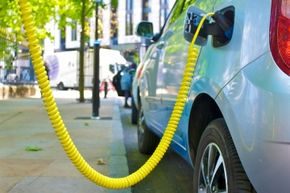
Then came the extended-range electric vehicle (EREV). The Chevy Volt is a prime example. It pairs a lithium-ion pack with a small gasoline generator. You plug it into a standard wall outlet. When the charge drops, the gas engine kicks in. It acts as a generator to keep the batteries topped up. This creates a new class of car. It bridges the gap between pure electric and traditional gas guzzlers.
8: Biodiesel
While electric powertrain tech grabs headlines, biodiesel offers a different path away from crude oil. It’s not a new fuel source. The concept dates back to the early days of the diesel engine itself. Rudolf Diesel originally designed his engine to run on peanut oil. Today, biodiesel is a renewable alternative derived from vegetable oils or animal fats.
Unlike electric cars that rely on charging infrastructure, biodiesel cars often use existing diesel engines with minor modifications. Or they can run straight up in modern diesel vehicles without any changes at all. This makes it a drop-in solution. You don’t need to overhaul your garage or wait for charging stations to pop up on every corner.
The environmental argument is strong here. Biodiesel is biodegradable and non-toxic. It reduces greenhouse gas emissions compared to petroleum-based diesel. It also burns cleaner, lowering particulate matter in the air. For enthusiasts who love the torque and sound of a diesel engine but want a greener footprint, this is a viable middle ground. It’s not as flashy as a Tesla. It doesn’t have that silent, instant acceleration. But it’s practical. And it uses fuel you can potentially make in your own kitchen waste or sourced from local farms.

You might think swapping out your morning bacon for kale extends to your gas tank. It doesn’t. While your arteries appreciate low-fat diets, your engine does not care about your cholesterol. Biodiesel exists. It is real. It is viable. But it is not a direct substitute for straight vegetable oil unless you want to turn your car into a very expensive paperweight.
How Biodiesel Actually Works
Biodiesel comes from renewable resources like vegetable oils or animal fats. Any standard diesel engine can run on it. That is the easy part. The hard part is that you cannot just pour used McDonald’s grease into a diesel injector. The raw material needs chemical conversion.
The process involves transesterification. You mix the oil with an alcohol (usually methanol) and a catalyst (like sodium hydroxide). This breaks down the triglycerides in the oil and replaces them with methyl esters. The result is fuel that behaves like petroleum diesel. Without this step, the oil is too viscous. It clogs filters. It gums up injectors. It destroys fuel pumps. You are essentially trying to run a sports car on motor oil. It ends badly.
The DIY Danger Zone
Enthusiasts often brew their own fuel. They buy waste oil from local restaurants. This keeps the oil out of landfills and creates a cheap energy source. It is a clever loop. But it is also a chemical hazard if you skip the training wheels.
Methanol is toxic. It can be absorbed through the skin or inhaled as vapor. The reaction generates heat and pressure. Get the ratio wrong and you do not get biodiesel. You get soap. You get glycerin sludge. You get a fuel system that costs more to fix than the vehicle is worth.
“Before trying to make biodiesel on your own, it’s a good idea to train for a while with someone who’s successfully done it before.”
Do not treat this like a science fair project. Treat it like handling explosives. Find a mentor. Watch the process. Understand the separation of layers. Test the purity. If you skip these steps, you risk damaging your vehicle, your house, and yourself.
The Smell of Success
Why do people do it? The cost is lower than petroleum diesel in many regions. The emissions are cleaner. It burns with fewer particulates and lower carbon content. It is a tangible way to reduce reliance on fossil fuels.
There is also the sensory detail. Your car will smell like french fries. Not the stale grease of a bad exhaust, but actual fried potatoes. It is a weird pride. It is a signal to anyone nearby that you are doing something different.
Just make sure your engine can handle it. Older diesels might have rubber seals that degrade with certain fuel blends. Newer ones are generally fine. Check your manual. Verify the blend. Do not just start pouring.
7: Ethanol
This leads us into the world of corn-based fuel. Ethanol is different. It is not oil. It is fermentation. It changes the rules entirely.

Skip the Fry Smell: Better Alternative Fuels for Your Daily Driver
You’ve got the deep-fryer grease down pat. Your tank is full of yesterday’s french fries. But let’s be honest—driving around town smelling like a diner’s exhaust pipe isn’t exactly a lifestyle upgrade. It’s messy. It’s persistent. And frankly, your neighbors are going to ask questions.
So, what’s the pivot? If you want to keep your exhaust clean and your fuel source domestic, you need to look at what’s growing in the fields, not what’s frying in the pan.
Why Ethanol Is the Green Choice
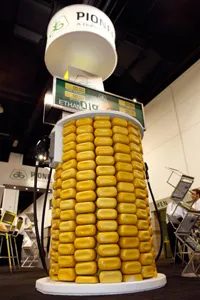
Ethanol isn’t new. It’s been hiding in your gas pump for years, usually tucked away in small percentages to lower emissions during the hotter summer months. It’s an alcohol-based fuel derived from plant matter.
Here is the breakdown:
– USA: Mostly corn.
– Brazil: Sugar cane.
– Rest of World: Various crops depending on local agriculture.
Do not drink it. It’s denatured for a reason.
The real story here is the infrastructure. Most major automakers now offer flex-fuel engines. These powerplants are engineered to handle a wide range of fuel blends. You aren’t forced into a corner. You can pump standard gasoline. Or you can fill up with E85, a blend that is roughly 85 percent ethanol and 15 percent gasoline.
The Geopolitics of Grain
Why does this matter to you?
It comes down to energy independence. The argument for ethanol is straightforward: we grow it here. We don’t have to negotiate with foreign regimes for our daily mobility. It is a renewable resource. Oil is finite. Corn is not.
But let’s not pretend it’s perfect. The production process is energy-intensive. You are trading one problem for another. And there is the ethical squeeze.
If farmers can make more money growing crops for ethanol than for food, they will switch. That reduces the food supply. That drives up food prices.
It’s a delicate balance between fueling your car and feeding the population.
Where to Find E85
The network is expanding. You can find stations that offer E85 in many parts of the Midwest and Great Plains, where the corn is king. Check your local listings. If your car is labeled as “flex-fuel” or “E85 compatible,” you are good to go. The tank won’t melt. The engine won’t choke.
You just need to be willing to pump it yourself.
6: Liquefied Natural Gas

Chefs know the stuff. You might have it in your kitchen. It isn’t ethanol. It isn’t biodiesel. It’s not made from anything you could eat or drink. It’s natural gas.
Top chefs insist on cooking with it. But in cars, it’s a different story. Specifically, a high-density story.
Natural gas sits between layers of underground rock. We drill for it just like oil. There’s a lot more of it in the United States. It burns cleaner than gasoline. Or oil.
The gas you use to boil pasta comes in at low pressure. That keeps it gaseous. Low pressure means low energy density. It releases relatively little heat when burned. Good for soup. Not good for hauling freight.
Cool it down. Change the state.
Liquefied natural gas (LNG) is the result. It becomes energy dense. Burn it, and you get massive power output. A truck needs that. Not just a little push. Serious torque over long distances. That’s where LNG lives.
5: Liquefied Petroleum Gas
Moving up the ladder. From methane to propane and butane.
LPG is distinct from LNG. It’s also an alternative fuel. But the source is different. Natural gas processing. Or crude oil refining.
It’s a byproduct. A secondary product.
The name sounds technical. Liquefied Petroleum Gas. But you’ve seen it. In camping stoves. In forklifts. In older taxi fleets.
How LPG Works in Vehicles
LPG is stored under pressure. It’s liquid in the tank. Vaporizes when released. Burns cleaner than gasoline.
Emissions drop. Particulates fall. Carbon dioxide emissions are lower too. But not as low as CNG or LNG.
The energy density is higher than compressed natural gas (CNG). Lower than gasoline. So range suffers slightly compared to liquid fuels. But it’s better than CNG.
Which Engine Type Fits Best?
Not every car handles LPG well. Most require modification. Or factory-built engines.
Flex-fuel vehicles? Sometimes. But dedicated LPG engines are more common.
Spark ignition. Otto cycle. Just like your average sedan. But tuned for propane-butane mixtures.
Air-fuel ratios shift. Injection systems change. Fuel lines need specific seals. Rubber degrades faster with LPG.
Where Is It Used?
Fleets love it. Forklifts use it globally. Indoor warehouses. No exhaust fumes choking workers.
Public transit? In some cities. Buses run on LPG. Cleaner air in tunnels.
Personal vehicles? Niche. Popular in Australia. South Korea. Eastern Europe.
Not so much in the US. Why? Infrastructure. Filling stations are rare. Unlike CNG networks.
Comparing LPG to Alternatives
LPG vs. CNG.
CNG is methane. Compressed. Lower energy density. Need bigger tanks.
LPG is propane/butane. Liquefied under moderate pressure. Higher energy density. Smaller tanks possible.
But LPG has higher CO2 emissions per mile than CNG. And higher particulates than LNG.
Still cleaner than diesel.
The Bottom Line
LPG isn’t the future of heavy
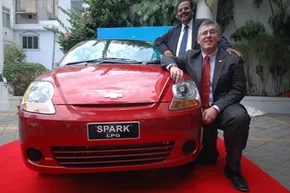
If you’ve stood near a backyard grill in the last decade, you’ve already met liquefied petroleum gas (LPG). You might call it propane by habit, but the chemistry tells a slightly different story. Propane is the dominant component, sure. But technically, LPG is a blend of hydrocarbon gases—propane, butane, maybe a touch of propylene—all kept in liquid form by pressure.
That pressure matters. It’s the same trick used for liquefied natural gas. Compressing it into a liquid increases energy density. Less tank space, more range. That efficiency is exactly why engineers decided to stuff it into car engines instead of just firing up the patio.
The setup isn’t magic. It’s an internal combustion engine specifically tuned for LPG. The fuel system injects the pressurized liquid, which flashes to gas before combustion. It works. It just isn’t mainstream in the US. Here, you’ll rarely see a fleet of LPG sedans. But look across the Atlantic. In the Netherlands, LPG accounts for 10% of all automotive fuel. Other countries have run pilots. The infrastructure exists. The technology works. The question is why we aren’t filling up with it.
4: Compressed Natural Gas
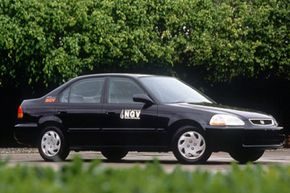
Imagine a fuel line running straight into your garage. Not a gas pump. Not a charging cable. Just a literal pipe. For compressed natural gas (CNG) vehicles, this isn’t sci-fi. It’s a logistical reality. The fuel is identical to what heats your home or boils your water. It travels through municipal lines, but your car can’t just plug into a wall outlet.
You need a compressor.
Standard household gas pressure isn’t enough to power an internal combustion engine effectively. You need high-pressure cylinders. CNG occupies significantly more volume than gasoline, so storage is a spatial puzzle. Honda tried to solve this with the Civic GX.
Launched in 1998, the Civic GX looked like a normal Civic. Under the hood, it was a different story. It burned cleaner. It cost less per mile. If you could afford the upfront installation of a home fueling station, the long-term savings were undeniable.
But there was a catch. A massive one.
There is no national network of CNG fueling stations. If you ran dry on a highway in Nebraska, you weren’t just inconvenienced. You were stranded. The infrastructure gap killed the momentum.
3: Compressed Air
So if gas lines are too limited and batteries are too heavy, what’s left? Air.
Compressed air cars don’t need lithium. They don’t need rare earth metals. They need a compressor and a tank. The concept is brutally simple. You compress air, store it under pressure, and release it to push pistons.
It sounds too good to be true because it is.
The physics are unforgiving. Air expands when released, cooling dramatically. This is the Joule-Thomson effect. You don’t just get cold; you get ice. Fuel efficiency is the killer. Compressing air takes a massive amount of energy. Releasing it gives back less than you put in.
The Efficiency Gap
Where does the energy come from? The grid.
In a gas car, you pump liquid fossil fuels. In an EV, you charge a battery. In a compressed air vehicle, you use electricity to spin a compressor. Then you store that energy as pressure. Then you release it.
Energy loss happens at every step.
- Compression generates heat.
- Storage loses pressure over time.
- Expansion cools the system.
No one has cracked the code on storing enough energy density to match a gas tank. A 50-gallon tank of gasoline holds roughly 115,000 watt-hours of energy. A high-pressure air tank holds a fraction of that.
The Zero-Emission Promise
The appeal is the exhaust.
Pure water vapor. That’s it.
If you could solve the energy density problem, these cars would be perfect for urban environments. No tailpipe emissions. No noise pollution. The compressors are quiet. The engines are mechanically simple. Fewer moving parts means lower maintenance.
But “simple” doesn’t mean “viable” for long-distance travel.
Who Actually Tried It?
MDI (Motor Development International) claimed they had a solution. Their AirCar was supposed to run on compressed air for up to 180 miles. The tank was integrated into the chassis. It looked futuristic.
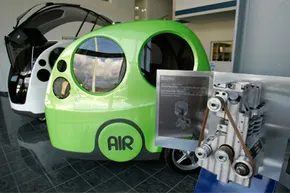
Air is infinite. It surrounds us. So why not burn it? Or rather, why not use its pressure to move metal?
Compressed air cars operate on a simple premise. You take air. You squeeze it into high-pressure tanks. Then you let it out.
A standard internal combustion engine mixes air with gasoline. It ignites that mixture. The explosion pushes pistons. A compressed-air engine skips the explosion. It relies on expansion. When the pressurized air leaves the tubes and enters the engine cylinder, it expands rapidly. That expansion forces the pistons down. Mechanical motion.
But there’s a catch. The air doesn’t come for free.
The Hybrid Reality of Pneumatic Drive
These vehicles are not purely mechanical. They are not purely electric either. They sit in a weird middle ground.
On board, you’ll find electric motors. But their job isn’t to spin the wheels. Not directly. The electric motors compress air and pump it into the high-pressure storage tubes. The electric motor acts as a pump. The compressed air acts as the battery.
This changes the architecture entirely.
In a Tesla or a Nissan Leaf, the electric motor is huge. It delivers torque directly to the drivetrain. In a compressed-air vehicle, the motor is significantly smaller. It only needs enough power to refill the tanks. It doesn’t need to haul the weight of the car across a highway.
This leads to a specific advantage. Charging time.
Because the onboard compressor draws less power than a direct-drive electric motor would require for propulsion, the recharge cycle is faster. You aren’t waiting for a battery to reach 80% capacity. You are waiting for air to be pumped into a tank. The energy density is low compared to lithium-ion, but the replenishment speed can be higher.
It’s inefficient by thermodynamic standards. Compressing air generates heat. Expanding it generates cold. Energy is lost in every cycle. But for short urban commutes? It’s a different path entirely.
2: Liquid Nitrogen

Liquid nitrogen is another alternative fuel. Like hydrogen, nitrogen is abundant in our atmosphere. Also like hydrogen, nitrogen-powered cars make fewer harmful emissions than gasoline or diesel. But while hydrogen is used in fuel cell cars as well as hydrogen-combustion engines, liquid nitrogen cars use a different type of engine altogether.
In fact, a liquid nitrogen car uses an engine similar to the engine used in a compressed-air car. In a liquid nitrogen car, the nitrogen is kept cold, keeping it in the liquid form. To power the car, the nitrogen is released into the engine where it is heated and it expands to create energy. While a typical gasoline or diesel-powered engine uses combustion to move pistons, a liquid nitrogen engine uses the expanding nitrogen to power turbines.
While it is a clean and efficient way to power a vehicle, liquid nitrogen faces the same hurdles as many other alternative fuels: At this time, there is no nationwide network of fueling stations to deliver it to consumers.
How Liquid Nitrogen Vehicles Work
The mechanics behind a liquid nitrogen car are straightforward but distinct from internal combustion. The fuel is stored as a cryogenic liquid. When it enters the engine, it absorbs heat from the surroundings. This causes rapid expansion. The expanding gas drives turbines instead of pistons. This process produces zero tailpipe emissions. The only byproduct is cold air.
This method differs significantly from hydrogen technology. Hydrogen can run in fuel cells or combustion engines. Liquid nitrogen requires a specific thermal expansion setup. The energy comes from the phase change and temperature difference. It is not a chemical reaction like burning gas.
The Infrastructure Gap
The technology works. The emissions profile is clean. The fuel source is everywhere. The problem is logistics. You cannot just pump liquid nitrogen into a car at a standard gas station. There is no nationwide network of fueling stations. This lack of infrastructure kills commercial viability. Without places to refuel, these cars remain novelties.
The same hurdle affects many alternative fuels. Batteries need charging networks. Hydrogen needs high-pressure stations. Liquid nitrogen needs cryogenic dispensers. Until someone builds the network, the cars stay in labs and museums.
1: Coal
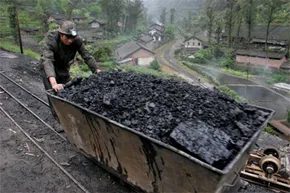
It feels counterintuitive. You picture a sleek EV gliding silently down the highway, and then someone mentions coal. The disconnect is jarring. Yet, for many drivers in the US, their electric vehicle is indeed burning coal. Not directly, of course. No one is shoveling black rocks into a battery port. The connection is hidden in the grid.
Electric cars don’t generate their own power. They store it. That energy comes from a wall outlet. The outlet pulls from the grid. The grid, in many regions, relies heavily on fossil fuels. Specifically, coal.
The Hidden Combustion Engine
Fifty percent of all electricity in the United States comes from coal-fired plants. That is a massive chunk of the national power mix. When you plug in a Chevy Bolt or a Tesla Model 3, you are drawing from a pool of energy that is half-coal. The electrons flowing into your car’s battery likely originated from a burner in a power plant hundreds of miles away.
This doesn’t mean EVs are dirty. It means they shift the pollution. Instead of tailpipe emissions in your city, you get smokestack emissions in a rural county. The location changes. The chemistry remains.
Cost and Supply Chain Benefits
There are practical upsides to this indirect relationship. Coal is cheap. Per mile, electricity derived from coal costs less than gasoline. It is a brutal arithmetic, but it holds true.
Supply stability is another factor. The United States has abundant coal reserves. This domestic abundance insulates drivers from international geopolitical shocks. You don’t have to worry about OPEC decisions or shipping lane blockages when your fuel source is dug out of the ground in Wyoming or West Virginia.
It’s Not All Coal, Though
Not every grid is brown. Some regions rely on hydro-electric power. Others use nuclear. If you live in an area with a green-heavy grid, your EV is running on water or atoms, not carbon. You can charge without adding to the coal emissions tally.
The reality is messy. Clean cars heading to dealerships are getting their energy from less-than-clean sources. It highlights a fundamental truth about energy systems. There is no free lunch. You are trading one type of infrastructure for another. The exhaust pipe moved. The problem didn’t vanish.
The Broader Picture
This final entry on alternative fuels shouldn’t be taken as an anti-EV rant. It is an observation about complexity. We want zero emissions. We also want reliable, cheap power. Coal provides that reliability. It comes with a carbon price.
The transition isn’t a binary switch. It’s a spectrum. And right now, the spectrum is weighted heavily toward coal in many parts of the country. Until the grid decarbonizes at scale, the “zero emission” label is more of a local definition than a global one.
You drive electric. But you also drive coal. The question is whether that matters to you.