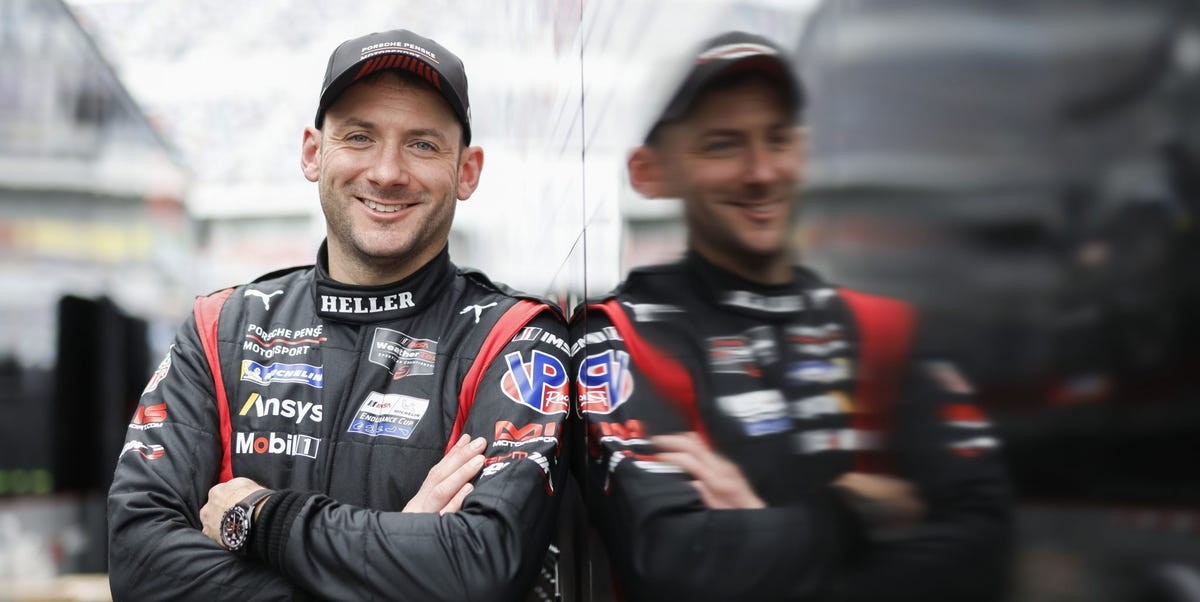
Nick Tandy has achieved a feat in motorsport history that no other driver, regardless of their legendary status, can claim. While icons like Timo Bernhard, Hurley Haywood, and Tom Kristensen boast incredible resumes, none have secured the Endurance Grand Slam. Tandy, a 41-year-old British driver, is the first person to win overall victories at the sport’s four most prestigious 24-hour races: Le Mans (2015), the Nürburgring (2018), Spa-Francorchamps (2020), and Daytona (2025).
This unique accomplishment has earned him the nickname “Mr. 24 Hours.” Yet, Tandy’s dominance extends even further. His victory at the 12 Hours of Sebring in 2025 completed the “Big Six,” making him the first driver to win all six of endurance racing’s major events.
Ahead of his latest IMSA appearance at WeatherTech Raceway Laguna Seca, where he pilots the iconic Porsche 911 GT3 R known as “Rexy” for AO Racing, Tandy reflected on his record-breaking career, the dangers of the track he calls the “Green Hell,” and the relentless focus that keeps him at the top of his sport.
Зміст
The Reality of Winning the “Big Six”
Winning the 12 Hours of Sebring in 2025 was not just another title for Tandy; it was the final piece of a historic puzzle. When asked how he processed completing the “Big Six” on that day, Tandy emphasized the difference between historical perspective and the immediate reality of racing.
“In the moment, you’re so focused on beating the competition on that day. That’s all that really matters. And that’s the most important thing and the bit that gives the most satisfaction.”
Tandy explained that while history will remember the day he completed the Grand Slam and the Triple Crown, the driver’s mindset is singular. The pride comes from outperforming every other team on the grid in real-time. The statistical milestones are a retrospective luxury; the victory itself is the only immediate reward.
Why the Nürburgring Remains the Ultimate Challenge
Among his four 24-hour victories, Tandy identifies the Nürburgring Nordschleife as the most difficult. Often called the “Green Hell,” the track’s reputation is built on more than just its length or lack of runoff areas. According to Tandy, the primary danger is its relentless speed.
Unlike many modern circuits that offer slow-speed corners for recovery, the Nordschleife is a continuous sequence of high-speed turns, predominantly in third, fourth, and fifth gears. This constant velocity, combined with the unpredictable weather of the Eifel region and minimal safety margins, creates a uniquely hazardous environment.
“If somebody built that track now and said, ‘Here you go, guys, come and do a race around here,’ the governing bodies and the manufacturers would turn around and go, ‘No, you’re absolutely stupid, we’re never going to do that,'” Tandy noted. “Because it’s so bloody dangerous. And when things go wrong there, they go wrong in a hurry.”
This perspective highlights a significant trend in modern motorsport safety: while new circuits are designed with extensive runoff and slower corners, historic tracks like the Nürburgring remain outliers, demanding a level of bravery and precision that is increasingly rare.
The Porsche Partnership: A Career Catalyst
Tandy’s success is inextricably linked to his long-term partnership with Porsche. He credits the Porsche Carrera Cup series as the turning point in his career. By entering a grid where every driver used the same car, Tandy could demonstrate his pure driving potential without the variables of equipment disparity.
“It evened the playing field, and it enabled me to basically make a career in the sport because I could show my potential… to many people watching.”
This relationship evolved from a simple racing arrangement into a collaborative development process. Tandy has moved from being a driver to an integral part of the engineering feedback loop, helping refine the very cars he races. This synergy has been mutually beneficial, allowing Porsche to maintain its legacy in sports car racing while providing Tandy with the platform to achieve historic victories.
Life with “Rexy” and AO Racing
This season marks a new chapter for Tandy as he transitions from Porsche’s factory Penske team to AO Racing, arguably the most popular privateer team in IMSA. AO Racing is renowned for its iconic Porsche 911 GT3 R, dubbed “Rexy,” which has become a cultural phenomenon in motorsport.
Tandy acknowledges the immense attention the car and team receive, noting that “Rexy” is known even to fans in the UK who have never attended a race in North America. However, he emphasizes that the pressure is matched by professionalism. AO Racing is a championship-winning organization with high standards in both North America and Europe.
“To compete, it’s the same attention to detail, the same amount of effort, and then the same reward when you get a result… If you put the work in and you work well together, the end result can be fantastic.”
For Tandy, the excitement surrounding AO Racing is positive for the sport as a whole, bringing renewed energy and visibility to endurance racing.
The Motivation Behind the Legend
Despite achieving records that seem impossible to break, Tandy’s motivation remains unchanged. He admits that he never actively chased records; instead, he focused on winning the next race. This incremental approach led to the accumulation of historic titles.
“I never thought I was going to win a 24-hour race. I never thought I was going to race at Le Mans… I attained them by winning the next race.”
His philosophy is simple: focus on the immediate task. If you perform better than your competitors in each individual event, victories will follow. There is no resting on laurels, no looking back at the Grand Slam. For Nick Tandy, the only thing that matters is the next race, the next challenge, and the next opportunity to prove his dominance on the track.
Conclusion
Nick Tandy’s career is a testament to the power of consistent excellence and strategic partnership. By conquering the Endurance Grand Slam and the “Big Six,” he has set a new benchmark for endurance racing drivers. Yet, his focus remains firmly on the present, driven by the immediate thrill of competition rather than the weight of history.