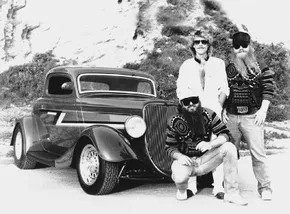
Rock and roll and hot rodding are basically siblings. They take something old, dusty, and maybe a little boring—blues scales or a 1932 Ford coupe—and inject it with horsepower and pure attitude. It makes sense that musicians love fast cars. But Billy F. Gibbons? He’s the king of the genre. His ZZ Top Eliminator hot rod isn’t just a car. It’s a cultural icon.
Зміст
How the ZZ Top Eliminator Was Built
The story starts in the early 1980s. Billy didn’t just walk into a garage and point at a pile of parts. He had a specific vision. He wanted something that screamed rock n roll, heavily inspired by Pete Chapouris’ The California Kid. So he hired Don Thelan at Buffalo Motor Cars.
Thelan took a 1933 Ford three-window coupe. He chopped the steel body three inches. That’s a serious chop. It lowers the roofline, changes the stance, and makes the car look aggressive from every angle.
The build team was stacked.
* Don Thelan handled the chop and overall build.
* Steve Davis fabricated a custom three-piece hood. He added unique “scooped” side panels that give the front end a distinct look.
* Kenny Youngblood designed the famous “ZZ” graphics. Those stripes are recognizable even if you’ve never seen the car in person.
The bodywork details matter. Thelan filled in the rear splash pan. He recessed the license plate for a cleaner look. He swapped in ’39 Ford teardrop taillights. Up front? Lowered ’34 Ford headlights. Every piece was chosen for aesthetics.
Under the Hood of the Eliminator
Billy isn’t into finicky high-performance motors that need a PhD to tune. He wants reliability. He wants to drive it. So the powertrain is straightforward.
At the heart of the ZZ Top Eliminator hot rod is a 350-cid Chevy V-8. Nothing exotic. It runs a Camaro Z-28 hydraulic cam. It has a polished intake manifold. A single four-barrel carburetor feeds the air and fuel. It’s simple. It’s capable. It’s bulletproof.
The transmission is a Turbo 350 automatic. No surprises there. But the finishing touch? Eric Vaughn milled the ZZ Top logo directly into the valve covers. It’s a small detail. It shows ownership.
The suspension setup is serious too. Underneath sits a Pete and Jake’s chassis. The front end uses a dropped tube axle with a four-bar suspension. The rear? A Ford nine-inch axle. This combination gives the car solid handling and a smooth ride. It’s not just a showpiece. It’s built to move.
From Album Cover to MTV Legend
The car existed before it was famous. But fame changed everything. A painting of the coupe appeared on the cover of ZZ Top’s 1983 album Eliminator. The album sold millions. The car became part of the brand.
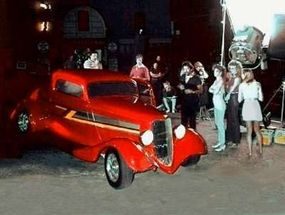
Then came the videos. MTV was king. The band featured the real car in four music videos. “Gimme All Your Lovin’
The Myth of the Keys and the Clone That Tourted
The video wasn’t just a car commercial. It was a fairy tale. A downtrodden teen, the kind who gets pushed around, gets swept off his feet not by love, but by a lowrider fantasy. Beautiful women arrive in the Eliminator. ZZ Top hands over a set of keys with a stylized ZZ chain. The car becomes a magical artifact. A plot device for salvation.
Gibbons’ Eliminator did something radical. It put a real hot rod in motion for an MTV generation that had never seen one outside a magazine spread. The exposure was immeasurable. It sparked interest in kids who didn’t even know what a tube chassis was.
Billy was already a rodder before the fame hit. The Eliminator was just his first car to go global. The demand for appearances? Insane. He couldn’t tour in the original. So he had California Street Rods build a clone. An exact duplicate for the road. He still owns both. The original. The tour car. Plus several other high-profile rods and customs in his stable.
He’s done as much for rodding as he has for rock ‘n’ roll. Maybe more. The car became the icon. The music followed.
The Eliminator wasn’t just a prop. It was a cultural reset button for hot rods.
Why the Eliminator Still Matters
You don’t need to be a musician to get it. The car bridged a gap. It took the subculture of custom cars and threw it onto the biggest screen in the world. It wasn’t subtle. It was loud. It was fast. It was exactly what the music was.
Billy didn’t stop there. He kept collecting. He kept building. The clone served its purpose. The original stayed safe. A smart move. You can’t risk the asset on a tour bus.
The legacy isn’t just in the vinyl. It’s in the steel. And the fiberglass. And the fact that kids started looking at old Fords differently. They saw potential. They saw a story.
And that story started with a set of keys.