


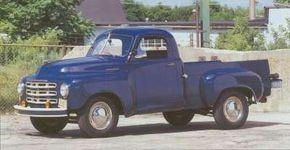
The year is 1948. April 28, to be precise. Nearly 1,300 people show up at Studebaker’s newly acquired, massive one-million-square-foot truck assembly plant. These aren’t just any visitors. They are dealers, salesmen, and special guests invited for a sneak preview of the company’s new commercial car line.
The vibe is electric. Optimism hangs in the air, thick and tangible. Everyone who walked out of that facility that day believed Studebaker’s truck business was about to shine as brightly as its historic reputation. They got to tour the giant plant. They saw how trucks were actually made. And they saw an impressive array of sparkling new trucks across various capacities, wheelbases, and body types.
But this wasn’t Studebaker’s first rodeo. The company was already a pioneer in commercial transportation.
A History Built on Hauling
Look back to 1852. Studebaker started building wagons. These world-famous wagons ran until 1920. They made history by moving generations west during America’s great migration period. They served just as admirably as workhorses for farm families and city merchants.
Then came the shift. In 1902, Studebaker unhitched the horsepower from the front of the wagons. They built its first self-propelled truck energized by an awesome array of electric batteries. It was a bold move. Gasoline wasn’t the only fuel in town yet.
The company marketed its first gasoline-powered truck in 1912. It was the Flanders delivery car. A year later, the Studebaker badge replaced the Flanders name. By 1917, the lineup included half- and one-ton chassis. You could get delivery, stake, express, or combination passenger and express bodies.
Then the Great War interrupted production. Truck building stopped. It wasn’t until 1925 that Studebaker re-entered the market. This time, they focused on buses, ambulances, and funeral cars built on the Big Six chassis.
Dominating the Niche Markets
The strategy worked. One year later, in 1926, Studebaker was the world’s largest producer of buses. They controlled 35 percent of all the ambulance and funeral car business in the United States. They had found their niche.
Early in 1928, a Studebaker-built Erskine was introduced. You could get it in either a screenside or panel delivery format. Shortly thereafter, similar bodies became available on the Dictator chassis.
The early Thirties brought expansion. Studebaker expanded its truck offerings to include models from half- to two-ton capacity. The most interesting of these was a half-ton model called a “boulevard delivery.” It sat on a 114-inch-wheelbase Dictator model GL chassis.
Then there was the 1933 Studebaker-built Rockne humpback deluxe delivery. That one rode on a 115-inch wheelbase. Studebaker continued to try to find a niche in the truck market with novel cab-forward models introduced in 1936. They even tried selling a few diesels.
The Coupe-Express: Styling Meets Utility
One of the most intriguing offerings during this era was the 1937 half-ton model J-5. Studebaker called it the Coupe-Express.
It featured passenger-car styling. A full steel body. A double-walled box. All the passenger-car amenities. Perhaps, above all, it was arguably the most attractive pickup on the market.
Moderate initial success prompted Studebaker to continue the car-based half-tonners into 1938. That was the K-5 model. And into 1939 with the L-5. But sales lagged. Only 1,000 of the K-5s were built. Only 1,200 of the L-5s followed.
In 1940, Studebaker used its new Champion as a base. They created a unique pickup coupe and sedan delivery. The pickup coupe was a standard business coupe with the trunklid removed and replaced with a small pickup box. The sedan delivery was a two-door sedan with the rear seat removed and sheetmetal blanks fitted over the rear glass.
These experiments defined an era. They showed how a wagon-maker adapted to the machine age. The optimism of 1948 wasn’t just about new trucks. It was about carrying that legacy forward into a post-war world that needed movement, and needed it fast.


