


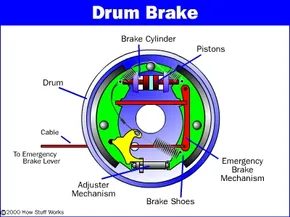
Opening up a drum brake assembly usually triggers a mild panic response. It looks like a tangle of metal, springs, and rusted pins that defies logic. But beneath the grime, the design is surprisingly logical. You have the standard two brake shoes and a hydraulic piston.
But then there is the rest.
There is the adjuster mechanism. The emergency brake cable routing. And a chaotic web of springs that seem to serve no obvious purpose until you understand the physics at play.
The Hidden Power of Self-Actuation
When you press the pedal, the piston pushes the shoes against the rotating drum. That part is identical to how a disc brake works.
So why the extra hardware?
Many drum brakes are self-actuating.
As the shoes drag against the drum, friction creates a wedging action. This isn’t just passive contact. The rotation of the drum literally pulls the leading shoe tighter into the drum’s surface. It amplifies the force.
This wedging effect increases braking torque without requiring massive hydraulic pressure.
That mechanical advantage is the whole point. It allows engineers to use a smaller piston in a drum system than you would need in a comparable disc setup. The drum does some of the heavy lifting.
Why So Many Springs?
The downside of this self-energizing design is that the shoes don’t want to let go.
Once those shoes are wedged tight against the drum, gravity and friction aren’t enough to pull them back when you release the pedal. If they stayed pressed, you’d have constant drag. Heat buildup. Wasted fuel.
This is where the springs become critical.
They aren’t just holding things together. They are actively fighting the wedging action.
- Return springs pull the shoes away from the drum surface to prevent drag.
- Hold-down springs keep the shoes aligned so they don’t rattle or shift out of position.
- Adjuster return springs snap the self-adjuster arm back into place after it has moved to compensate for pad wear.
Without this spring tension, the brake would seize. The simplicity of the disc brake—where a piston simply retracts and a caliper squeezes—is lost in favor of mechanical complexity.
You are trading ease of maintenance for raw stopping power.
The drum doesn’t just brake. It grabs. And getting it to let go requires a lot of spring force.


