


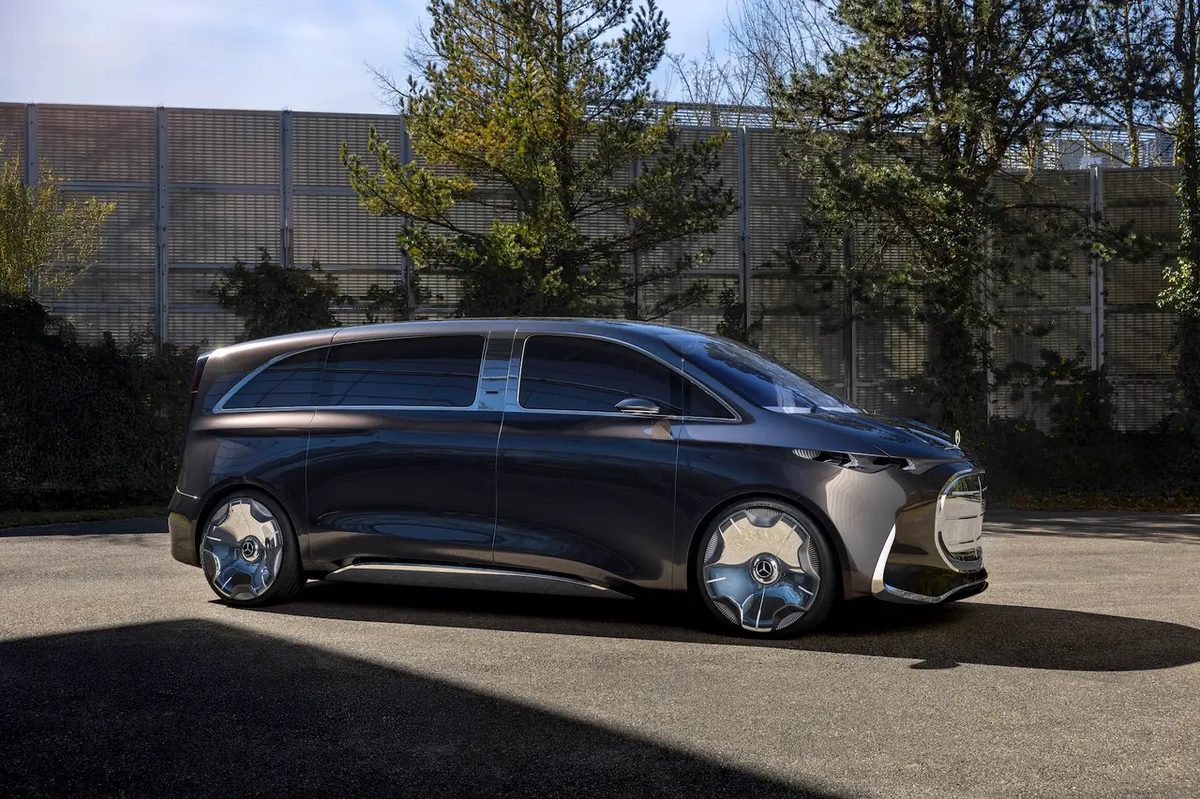
Mercedes isn’t just tweaking the S-Class anymore. They are trying to build an entirely new class of luxury electric haulers. The Le Vision V concept is the blueprint. It points toward two specific production models coming in 2026: the VLE and the VLS.
This isn’t about volume sales. It’s about prestige. The goal is to merge massive interior space with high-end tech and that unmistakable Mercedes comfort. The target? Asian markets. Demand for premium electric vans is spiking there, and Mercedes wants to own that segment.
Зміст
Bold exterior styling
The front end looks aggressive. We’re talking about a massive grille with illuminated chrome slats. Thin headlight clusters connect across the face via a continuous LED strip. The hood features the traditional Mercedes star on a raised pedestal. Classic moves.
But then you hit the wheels.
24-inch rims. They are borrowed directly from the Maybach design language. That adds serious elegance to what is essentially a large van shape.
Lighting details
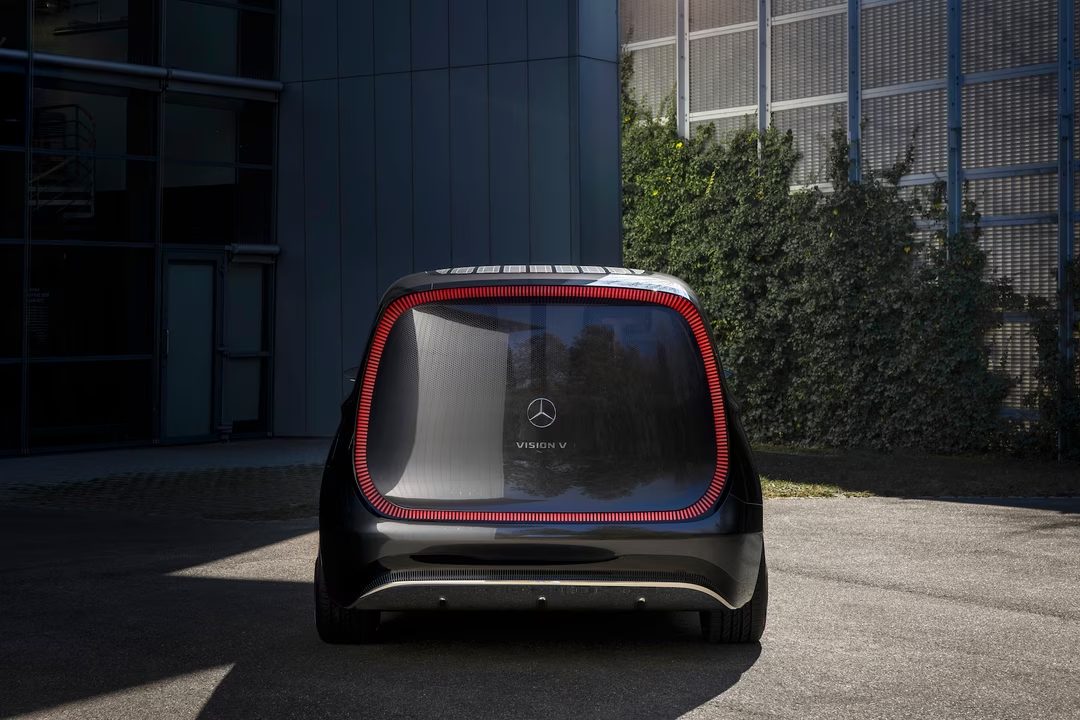
Look at the rear. The taillights are made up of 450 individual LEDs. They surround a glass rear window. The effect is premium. It’s clean. It’s futuristic.
The design language here is bold. It signals that Mercedes sees this vehicle category as a canvas for their most advanced styling cues. The Le Vision V concept serves as a direct teaser for the VLE and VLS models expected in 2026.

First-Class Comfort, Not Just Transport
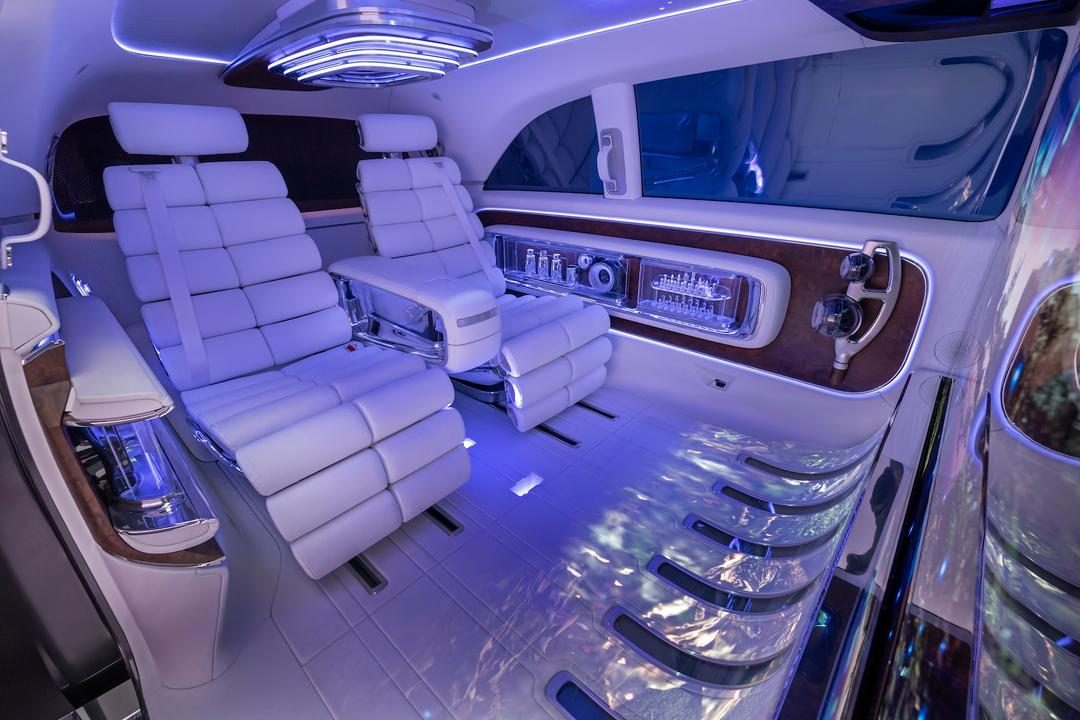
The Vision V’s cabin isn’t just an interior. It’s a private lounge on wheels.
You’re sitting in white crystal Nappa leather. Real wood accents meet polished aluminum. The rear seats? They aren’t bolted down. They’re individual pods. Inspired by business-class aviation, they recline fully. A multifunctional center console splits the back row.
It’s luxury defined by isolation. You don’t share the space. You occupy it.
A Cinema on Wheels and Under the Floorboards
Forget the rear seat entertainment screens bolted on like an afterthought. The Vision V does something far more aggressive. It pulls a sixty-five-inch 4K panel up from the floor.
Yes. From the floor.
It’s not just a gimmick. It’s a statement. The screen retracts when not in use, leaving the cabin floor clean. When deployed, it’s massive. The perspective shifts. You aren’t watching a movie. You’re inside it.
The Sound Stage
Silence is luxury. Noise is cheap. That’s why the audio setup here isn’t standard. It’s a forty-two-speaker Dolby Atmos system.
Think about that number. Forty-two.
Most flagships offer a dozen. High-end trims might scrape eighteen. The Vision V goes all-in. The sound doesn’t just come from the doors or dash. It envelops. It surrounds. It presses against you. Paired with the ambient lighting and the overall scale, the cabin stops feeling like a car. It feels like a private theater.
But theater seats don’t usually drive themselves.
Under the Skin: VAN.EA and 800V
The glamour of the interior is only half the story. The other half is hidden beneath the floor panels. The Vision V sits on the new VAN.EA modular platform.
This is dedicated architecture. It’s not a modified combustion engine chassis with a battery shoved in the middle. It’s electric from the ground up.
The headline spec here is the 800-volt electrical architecture.
Why does that matter? Charging speed.
With 400-volt systems, you’re often stuck waiting. You plug in, you grab a coffee, you wait some more. The 800-volt setup changes the math. It allows for rapid charging capabilities that actually make long-distance travel viable without the anxiety of range depletion. It’s not just about going farther. It’s about wasting less time plugged in.
The platform promises high performance, but the real win is efficiency. The structure is optimized for electric propulsion, meaning less weight, better power distribution, and a chassis that can handle the torque without feeling heavy.
Displaying What Matters
While the screen rises from below, the center console offers a different kind of luxury. Retro-lit showcases.
Not just storage. Display cases.
Backlit glass shelves for your personal objects. Your watch. Your sunglasses. Maybe a small artifact you’ve collected. The lighting is tuned to highlight, not just illuminate. It turns the cabin into a gallery.
It’s excessive. It’s unnecessary. And it’s exactly what defines the upper echelon of modern automotive design.
Is it practical? No. You could argue that a sixty-five-inch screen is a safety hazard, or that forty-two speakers are overkill. But practicality isn’t the goal here. The goal is immersion.
The Vision V isn’t trying to be a commuter. It’s trying to be a destination.


