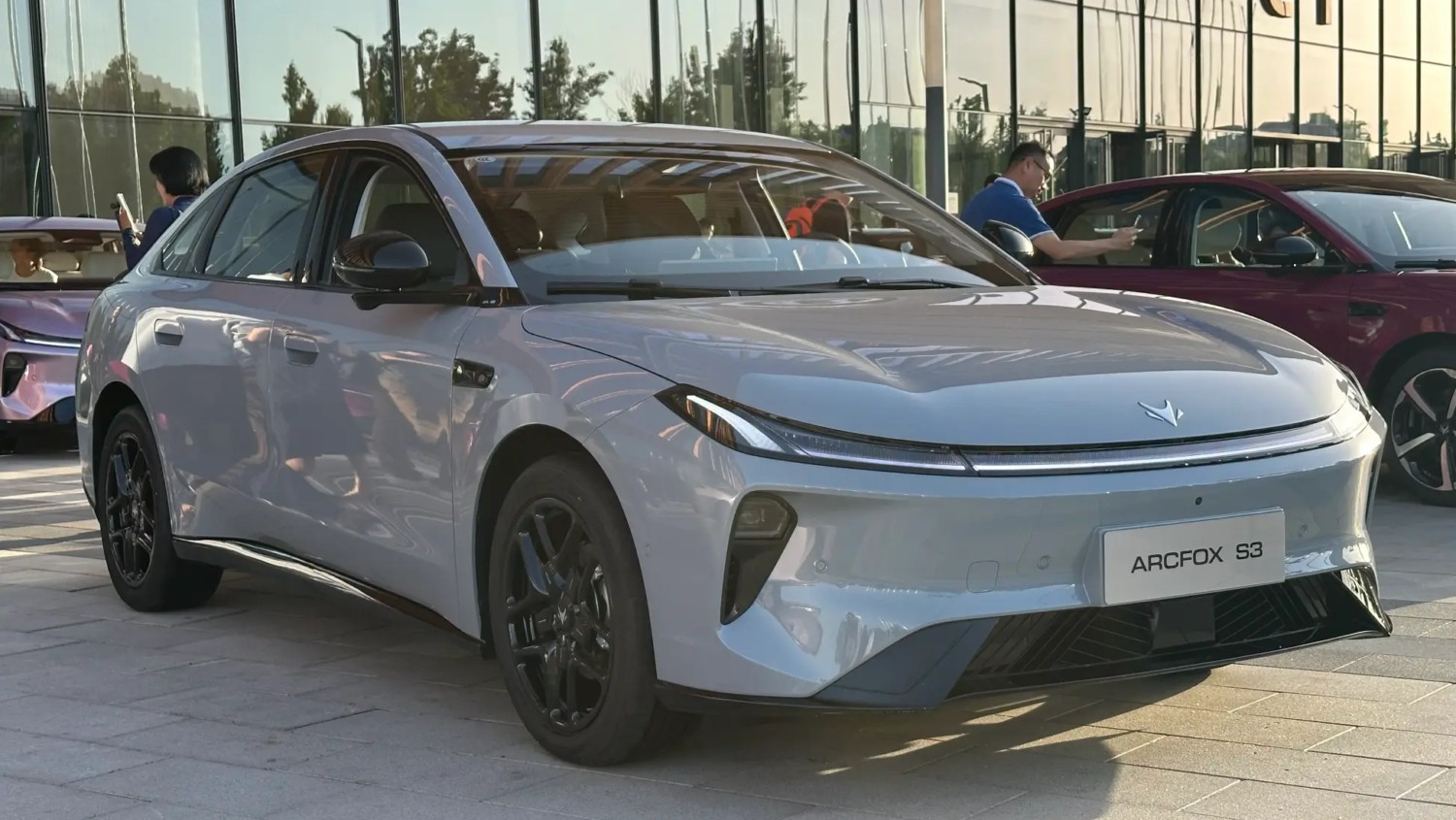
It launches today. May 22, 25. China. The Arcfox Beta S3 is here, and BAIC didn’t bother whispering about it.
They just dumped the info out there. Over 30,000 people pre-ordered this thing since late April. Why? Because it plays well with the giants. Specifically, CATL. This car plugs straight into China’s massive battery-swapping network.
No waiting in line for a charger while you sip overpriced coffee. Just drop in a fresh brick and drive off.
Зміст
Price matters here
Let’s talk numbers, since that’s the only thing that gets people off the couch these days.
The starting price is 59,800 RMB. That’s about 8,800 US dollars.
Wait. Let that sink in. You can walk away with this mid-size sedan for under nine grand? Top trim hits 120,809 RMB, roughly 17,800 bucks. Not bad, even for China’s fierce EV market.
If you choose Battery as a Service (BaaS), you split the cost differently.
– Pay 399 RMB ($58) a month for 5,000km.
– Pay 599 RMB ($87) a month for unlimited mileage.
Which deal wins? Depends on how much you drive, obviously.
It looks… okay?
“Super-level light and shadow” is the official design language. Sounds like a bad sci-fi novel.
What you actually see is a closed grille, split LED strips, and a fastback shape that tries to look sporty without being aggressive. It’s long (4.9m), wide (1.9m), and has an active rear spoiler that pops out. Semi-hidden door handles. It looks like every other sleek electric sedan, but maybe the dimensions are right for families who hate bulky SUVs.
Sleeping arrangements
Get in. Look around. There’s a big floating screen—15.6 inches. Another smaller one behind the wheel for your speed and warnings.
But the weird flex here? Comfort.
Front seats fold completely flat. You get 1.8 meters of sleep space. Rear seats recline to 118 degrees. Add that massive panoramic roof (1.1 square meters of glass above your head) and ambient lighting, and it starts feeling less like a car and more like a lounge chair on wheels.
Are we buying cars for transportation or naps? Who knows anymore.
Boring specs, fast results
Everything is front-wheel drive. A 213 horsepower motor. 7.1 seconds to 100km/h. It’s not fast, it’s just adequate.
Where it gets interesting is the range game.
Swappers get 535km (CLTC) and a 99-second battery swap. Less than two minutes. You can pee, grab a snack, and have a new battery.
Chargers go further. 560km or 660km depending on the battery. Fill from 30 to 80 percent in under half an hour. Standard stuff now, but still annoying compared to swapping.
Smart enough
Qualcomm Snapdragon 8155 handles the screens and infotainment. No drama there, just smooth operation.
High-end models get LiDAR. Actually real LiDAR. Plus the Horizon Robotics chip. This unlocks Navigate on Autopilot (NOA) for both highways and cities, plus automatic parking. It’s L2+, so keep your hands on the wheel. It helps, but it’s not driving for you.
We keep telling ourselves self-driving is years away. Then companies sell cars with lasers on the roof and city driving modes. How many years is “soon” now?