Buying tires is stressful. The jargon from salespeople is worse. Sidewall markings look like a cryptic code. You want to understand what you already have. Or you just need new rubber. Either way, the variables are exhausting. Let’s break down the anatomy of a tire. We will cover the build. We will decode the numbers. You will learn why heat kills tires. And you will fix your pressure. No fluff. Just facts.
Зміст
The Anatomy of Rubber
A tire is not a simple tube. It is a composite structure. It supports the weight of your car. It handles lateral forces. It dissipates heat. If you ignore the internal construction, you risk failure. The sidewall holds the information you need. But only if you can read it.
Reading the Sidewall Code
Every tire carries a specification code. It is molded into the rubber. This code tells you everything about the fitment. Ignore it at your peril. Here is how to parse it.
- P-Metric vs. Metric : Most passenger cars use P-metric tires. The “P” stands for Passenger. Some European cars use ISO metric tires. They start with a width number directly.
- Width : The first three digits are the width in millimeters. A 205 means the tire is 205mm wide from sidewall to sidewall.
- Aspect Ratio : The next two digits are the height of the sidewall as a percentage of the width. A 55 means the sidewall is 55% of 205mm. That is roughly 112.75mm.
- Construction : The letter “R” stands for Radial. This is the standard for almost all modern cars. Belts run radially across the tire.
- Diameter : The final two digits are the rim diameter in inches. A 16 fits a 16-inch wheel.
Understanding Load and Speed
The numbers don’t stop at size. Two more digits follow. These are critical for safety.
- Load Index : A number like 91. This corresponds to a maximum load capacity. For 91, it is 1356 lbs per tire. You must check the total weight of your vehicle. Divide by four. Ensure your tires meet or exceed that number.
- Speed Rating : A letter like “W”. This indicates the maximum sustained speed. “W” is 168 mph. “H” is 130 mph. “T” is 112 mph. Never go lower than the OEM rating.
Why Heat is the Enemy
Tires generate heat. Friction does. Deformation does. The rubber flexes as it rolls. This flexing creates internal heat. If the pressure is low, the sidewalls flex more. More flex equals more heat. Heat degrades the rubber. It breaks down the belts. Eventually, the tire fails.
Low pressure is the primary cause of tire failure. It causes excessive sidewall flexing and heat buildup.
You must check pressure when tires are cold. Driving raises the temperature. Reading will be higher. Add air based on the cold rating. Do not bleed hot tires.
Common Mistakes
People buy
Look at a tire under a microscope and you’re looking at a complex engineering puzzle. It’s not just a rubber donut. It’s a layered assembly of steel, fabric, and chemical compounds working together.
The Bead and Body Structure
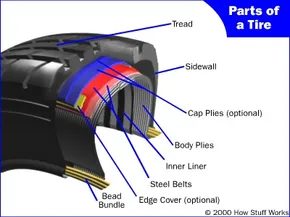
The foundation starts at the bead bundle. This is a loop of high-tensile steel cables wrapped in rubber compound and bead filler. Without this, the tire couldn’t grip the wheel rim. It also has to survive the violent forces of mounting machines squeezing it onto steel.
Inside, you have the body. This consists of multiple fabric layers called plies.
– Plies : Most tires use polyester cord. In a radial tire, these cords run perpendicular to the tread. Older bias-ply tires had cords running diagonally.
– Bonding : Rubber coats these plies to seal air and bond components.
– Strength : A standard car tire has two body plies. A commercial jetliner tire? Thirty or more.
Belts and Cap Plies
Modern tires rely on steel-belted radial construction.
– Steel Belts : Reinforce the tread area. They offer puncture resistance and keep the tire flat against the road for maximum contact patch.
– Cap Plies : Not all tires have them. These are extra layers of polyester fabric. They appear mostly on high-speed-rated tires to keep components from shifting apart at velocity.
Sidewall and Tread Basics
The sidewall provides lateral stability. It protects the body plies and holds the air in. Some designs add extra components here to stiffen the sidewall.
The tread is a mix of natural and synthetic rubbers. Initially, it’s just a smooth, solid block of rubber called a tread block. It has no grooves yet. Those traction patterns come later.
Assembly and Vulcanization
All these parts meet in a tire-building machine. It places every component with precision, forming the tire close to its final size. But right now, it’s loose. No markings. No tread pattern.
This is the green tire.
Next, it goes into a curing machine. Think of it like a waffle iron.
– Molding : Presses in the tread grooves and sidewall markings.
– Vulcanization : Heat bonds everything together chemically.
After final inspections, the tire is ready.
Decoding the Sidewall Numbers
Every string of numbers on the sidewall tells a specific story. Here is how to read the code.
Tire Type Designations
The letter at the start defines the vehicle class.
– P : Passenger vehicle. The most common.
– LT : Light truck. Built for heavier loads.
– T : Temporary spare. The “donut.”
Understanding Tire Width
The first set of numbers, like 235, indicates width in millimeters. This is the measurement from sidewall to sidewall.
Crucially, this measurement assumes the tire is mounted on its intended rim width. A narrower or wider rim will change the actual footprint slightly.
Aspect Ratio Explained
The next number, such as 75, is the aspect ratio. It represents the tire’s height from bead to tread top as a percentage of the width.
Calculation for a 235/75 tire:
– Width: 235 mm
– Height: 75% of 235 mm = 176.25 mm (approx. 6.94 inches).
A lower aspect ratio means a shorter, stiffer sidewall. High-performance tires use low profiles because stiff sidewalls resist lateral forces during cornering. They don’t flex as much, keeping the car planted.
Construction Type
The letter R stands for radial construction. This is the industry standard.
Older tires might show:
– D : Diagonal bias
– B : Bias belted
A separate note often details the ply count in the sidewall and tread areas separately.
Rim Diameter
The final number specifies the wheel diameter in inches. This is non-negotiable. You cannot mount a tire designed for a 15-inch wheel onto a 17-inch rim. The bead won’t seat. The air won’t hold.
Understanding these specs isn’t just trivia. It dictates how your car handles, how it stops, and whether it stays on the road when things get slippery. The numbers are the blueprint.
UTQG is a standardized grading system for passenger car tires. The U.S. National Highway Traffic Safety Administration (NHTSA) maintains the database. You can find specific ratings there. The label on your sidewall provides three distinct data points.
Tread Wear
This number is derived from controlled tests on a government track. It’s a relative measure, not an absolute promise. A higher number means the tread should last longer than a lower number. Real-world driving rarely mimics test track conditions. Surface textures and speeds vary. Your actual mileage may differ.
Traction
The scale runs AA at the top to C at the bottom. This rating measures braking performance on wet concrete and asphalt. It does not account for cornering ability. Consider the Firestone Wilderness AT and Radial ATX II. These tires have drawn attention in recalls and news cycles. Both hold a traction rating of B.
Temperature
Heat dissipation determines the temperature grade. Options are A, B, or C. Proper inflation and load limits are required for these ratings to hold. Underinflation causes excessive heat buildup. Overloading does the same. Excessive speed accelerates the problem. Heat leads to faster wear or total failure. The same Firestone models mentioned above carry a temperature grade of C.
Service Description Breakdown
The service description holds two critical metrics.
Load ratings define maximum capacity. A load index number correlates directly to weight support. Index 105 supports 2039 pounds (924.87 kg). The tire sidewall also notes the specific inflation pressure required for that load.
Speed ratings follow the load index. A letter indicates maximum allowable speed. This applies only if the load is at or below the rated limit. Rating S allows up to 112 mph (180.246 kph). Other letters cover different velocity caps.
Calculating Tire Diameter
Understanding the numbers lets you calculate overall diameter. Start with tire width. Multiply by the aspect ratio. This yields the sidewall height.
For a 235/75R15 tire:
Height = 235 x 0.75 = 176.25 mm (6.94 in).
Add twice the sidewall height to the rim diameter.
2 x 6.94 in + 15 inches = 28.9 in (733.8 mm).
This is the unloaded diameter. Put weight on the tire and the diameter shrinks.
Decoding Traction Terms
The industry uses many terms. Some mean something. Many do not.
All-Season Mud and Snow (M+S)
Seeing MS, M+S, M/S, or M&S on the sidewall means the tire meets Rubber Manufacturers Association (RMA) guidelines. It is a mud and snow designated tire.
Requirements are geometric. They depend on mold dimensions.
- Tread pockets or slots must extend toward the center.
- At least 1/2 inch from the footprint edge.
- Minimum cross-sectional width of 1/16 inch.
-
Edges angled between 35 and 90 degrees to travel direction.
-
The tread contact surface must be at least 25 percent void area.
In plain English, the tire needs substantial grooves. They start at the edge and run inward. The grooves must cover at least a quarter of the surface. It’s a baseline for light off-road capability. Nothing more.
Severe Snow Use Testing
Standard M/S ratings don’t require actual snow testing. They rely on geometric tread patterns. That changes with the Severe Snow Use designation.
You need the extra void space to bite through deep packs. But geometry alone isn’t enough proof for harsh winters. The Rubber Manufacturers Association stepped in. They created a real-world standard.
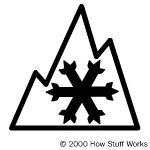
Look for the three-peak mountain snowflake icon. It sits right next to the M/S marking. This signals Severe Snow Use certification.
The bar is higher here. Tires must pass ASTM procedures. Specifically ASTM F-1805 for snow traction. The goal? A traction index of 110 or higher. This compares directly to the ASTM E-1136 reference tire. The test uses equivalent loads.
If the tire doesn’t outperform the standard reference, it fails. It stays off the label. This isn’t just about sipes. It’s about proven grip in slush and ice.
Hydroplaning Dynamics
Hydroplaning happens when water can’t escape. Fast driving over standing water lifts the tire. The tread loses contact with asphalt. The car rides on a film of liquid.
Control vanishes instantly. Steering becomes useless. Braking distance skyrockets.
Manufacturers fight this with tread design. Deep grooves run parallel to rotation. They act as drainage channels. Water squirts out sideways. Pressure builds less under the tread.
It’s simple physics. More channel volume means better evacuation. Less risk of lifting off.
How Tires Support a Car
Thirty psi seems weak. Yet it holds up a two-ton sedan. How?
Look at the tire. It’s not a perfect circle. The bottom flattens. This is the contact patch. It’s the only part touching the road.
Imagine looking up through a glass street. You’d see a footprint for each wheel. Measure that area. Add them up. Multiply by the tire pressure. The result is roughly your car’s weight.
Pressure times area equals load. Simple.
If you add cargo, the patch grows. The tire flattens more. If you lower pressure, the patch expands too. More surface area distributes the weight.
No magic. Just physics doing its job. But get the patch wrong, and handling suffers. Grip drops. Wear increases. It’s a constant balancing act between comfort, efficiency, and traction. And that’s just the start of what tires actually do.
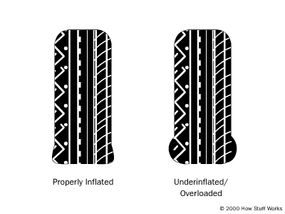
Look at the shape of the tread. A properly inflated tire holds its roundness. An underinflated or overloaded one flattens out where it meets the pavement.
When that tire spins, the contact patch has to constantly reshape itself to stay glued to the road. Rubber bends. Steel belts flex. It takes physical force to deform that material.
And rubber isn’t perfectly elastic.
When the tire snaps back into shape after leaving the contact patch, it doesn’t give back all the energy you put in. Some of that force gets lost. It turns into heat through the internal friction of bending rubber and steel.
The more a tire has to flatten, the more work it has to do. More work means more heat.
This is why underinflation kills tires. It’s not just about grip. It’s about thermodynamics.
What Are CRF Numbers?
Manufacturers publish something called the Coefficient of Rolling Friction (CRF).
Don’t confuse this with traction. CRF has nothing to do with how well you grip a corner. It’s a measure of drag. It tells you how much resistance the tire creates just by rolling.
The math is simple. Force equals CRF multiplied by the load on the tire.
Here is what those numbers look like in the real world:
- Low rolling resistance car tire: 0.006 – 0.01
- Ordinary car tire: 0.015
- Truck tire: 0.006 – 0.01
- Train wheel: 0.001
Let’s do the math for a typical sedan.
Say your car weighs 4,000 pounds (1814 kg). You’re running standard tires with a CRF of 0.015.
4,000 times 0.015 equals 60 pounds of constant force.
You have to push against that 60 pounds of resistance every single mile.
Power equals force times speed. So the energy cost depends entirely on how fast you’re moving.
At 75 mph, those tires are consuming about 12 horsepower just to overcome rolling resistance.
Drop down to 55 mph, and it’s still 8.8 horsepower.
That power doesn’t disappear. It turns into heat.
Most of that heat stays in the tire. Some of it transfers to the road surface (the asphalt actually flexes slightly under load), but the tire takes the brunt of it.
The three factors that dictate heat buildup are tire weight, speed, and CRF. Lower pressure increases CRF.
Drive on sand and the dynamic changes. The ground absorbs more heat, but your CRF spikes massively.
Problems With Tires
Heat is the enemy. And it’s accelerating.
When you combine low pressure with high speed, you’re cooking the tire from the inside out. The structure weakens. The rubber degrades.
It’s not a matter of if the tire will fail eventually. It’s a matter of when and how violently.
The sidewalls work harder. They flex more. They get hotter.
You can feel it in the steering wheel at high speeds if you’re paying attention. The resistance changes.
But by then, the damage is often already done. Internal separation. Blistering.
You don’t need a mechanic to tell you your tires are underinflated. You can see the shape change. You can hear the hum.
But you need the math to understand why it matters.
It’s not just gas mileage. It’s safety.
A flat tire doesn’t just look bad. It acts like a furnace.
The heat generated by rolling resistance is real energy. It’s pulling that energy from your engine. From your fuel tank. From your wallet.
And if you ignore it long enough, the tire explodes.
Or just falls apart.
There’s a fine line between efficient rolling and structural failure. Most drivers never see it.
They keep driving. The temperature climbs.
Until the rubber can’t take it anymore.
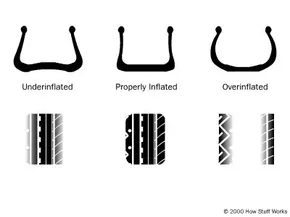
Underinflation is a silent killer of your fuel economy and tire integrity. When pressure drops, the tire’s outer edges bear the brunt of the load. You’ll see uneven wear developing on the outside shoulders long before the center shows any signs of life. This deformation generates excess heat. Heat degrades rubber. It also increases rolling resistance, meaning your engine works harder to push the car forward. The result? Reduced mileage and a higher risk of a blowout.
Check your pressure monthly. Use a gauge. Don’t rely on the dashboard light alone; it’s often a late-warning system.
Overinflation tells a different story. Here, the center of the tread takes the hit. The tire bulges outward, concentrating weight in the middle. This leads to rapid wear in the center rib pattern. Manufacturers often recommend pressures lower than the maximum listed on the sidewall. Why? Comfort. Lower pressure absorbs bumps better. But if you’re chasing maximum fuel efficiency, higher pressure within safe limits reduces rolling resistance. Just stay below the max limit. Exceeding it compromises grip and ride quality.
Misalignment throws a wrench in the works. It’s not just about straight driving. Improper toe or camber settings cause the inside or outside edges to wear unevenly. Sometimes the tread looks torn or rough. This isn’t just cosmetic. It affects handling stability and safety.
We often think of tires as simple rubber tubes. They aren’t. They are complex assemblies. There’s a radial cord body. Adjacent tread ribs. Inner liners. Steel belts. Polyester cords. Each component plays a role in how the tire interacts with the road. When you shop for replacements, keep these wear patterns in mind. They dictate longevity. They dictate safety.
Tire FAQ
What are tires made of?
Steel, polyester, and rubber. That’s the basic triad. But the construction is intricate. Steel belts provide strength. Polyester cords offer stability. Rubber compounds provide traction and flexibility.
What does the small print on a tire mean?
The sidewall is a data sheet. It lists the tire type. Width. Aspect ratio. Construction method. Rim diameter. Uniform tire quality grading. Service description. It’s dense information. But it’s essential for compatibility.
What are common problems with tires?
Underinflation. Overinflation. Misalignment. These are the big three. They all lead to uneven wear. They all compromise performance.
How long can you keep a tire?
Car and Driver suggests replacement between six and ten years after purchase. Age degrades rubber. Even if the tread looks good, the structure may be compromised. Check the manufacture date on the sidewall.
What is hydroplaning?
It happens when you drive through standing water. The tire can’t displace the water fast enough. The tire lifts off the pavement. It rides on a layer of water. Traction vanishes. Control is lost. It’s terrifying. It’s avoidable with proper tread depth and speed.