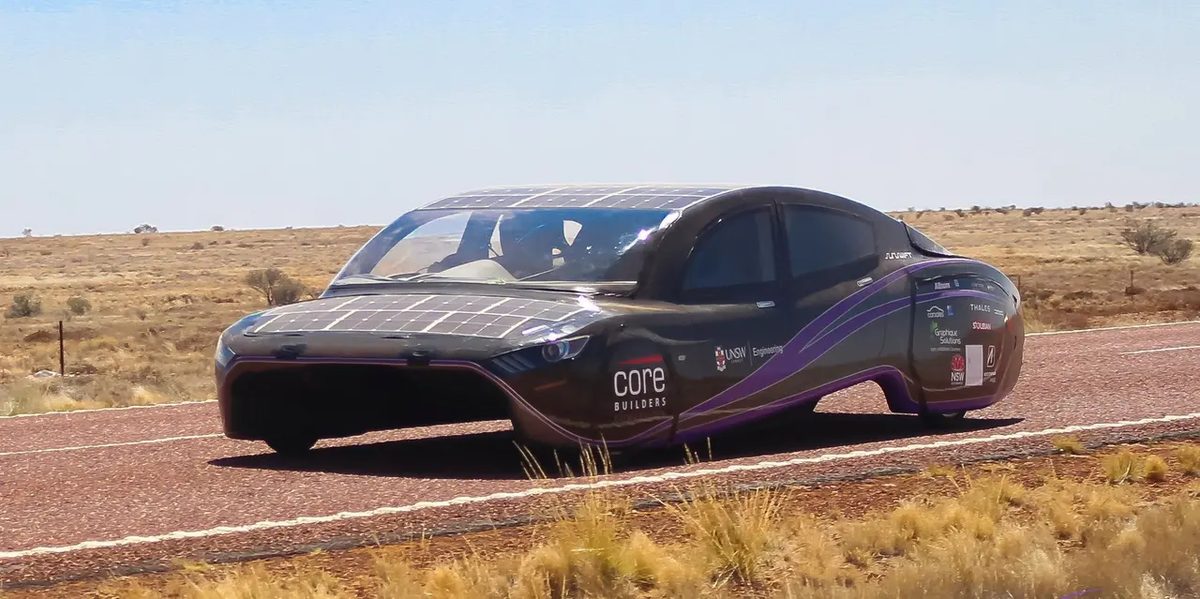
The UNSW students didn’t just adjust the prototype. They broke expectations. Their solar-powered car, named Violet, traveled across the Australian continent from Perth to Sydney. It is a long distance of 4100 km.
It runs on $50 worth of energy.
6 days. How long will it take to cover that distance? Average consumption? Power consumption is 3.25 kWh/100 km.
Compare this to the previous peak value of 5.5 kWh/100 km for this route. Profitability is more than just a statistical improvement. This is a huge leap forward in terms of the amount of energy it takes to move a vehicle across the country.
This isn’t a flimsy single-seater built for the track. Violet is part of the Sunswift team and is built for reality. There are 4 seats. 4 doors. A front trunk. A rear boot. parking radar. rear camera.
Looks like a car. Drives like a car.
The secret lies in the weight. Thanks to the carbon fiber frame, the entire vehicle weighs only 360 kg. Here, lightness is strength.
How Violet achieves 3.25 kWh/100 km
Underneath the stylish body structure is a battery pack with a capacity of 10-20 kWh with lithium ion batteries. But the real magic lies beneath the surface.
The roof, hood and rear deck are covered with 318 monocrystalline solar cells. The efficiency of the panels is up to 22%. It uses the battery directly and uses only sunlight to keep the wheels spinning.
Propulsion comes from two hub motors attached to the rear wheels. They pushed the lightweight chassis to a top speed of 140 km/h. This is not a drop. For mainly solar-powered vehicles, this corresponds to highway speed.
The Violet consumed an average of 3.25 kWh/100 km during 4,100 km of driving.
This is the sixth solar car model designed by the Sunswift team. They are regulars at the annual World Solar Challenge, which runs from Darwin to Adelaide. However, this trip from Perth to Sydney was different. This shows not only speed but also durability and efficiency.
Why is solar power technology important now?
Most solar cell prototypes are science projects. They rarely leave the lab. This technology is rarely seen on showroom floors.
This is changing.
Car manufacturers are also starting to pay attention. Hyundai Motors and Kia Motors have announced that starting next year they will offer photovoltaic roof options for gasoline, hybrid and electric car models. It’s a small step. Some might call this a “timid breakthrough.” But it means change.
Then there is the Sono Sion. An electric minivan with solar power costs 16,000 euros. It is scheduled to be released in 2019.
Sunswift Violet proves that our core technology works. This shows that solar-assisted driving is more than just an endurance driving trick. This is a viable way to reduce energy consumption on public roads.
It’s not a question of whether.