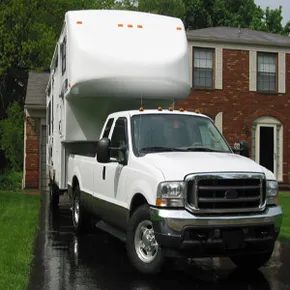
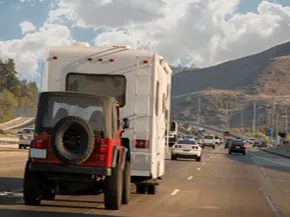
Forget the trailers. Skip the dollies. If you want to tow a four-wheeler behind your motor home, the rigid A-frame tow bar is likely your best bet. It is the simplest, lightest, and cheapest option on the market.
A tow bar connects your RV to a car, dragging the smaller vehicle on its own wheels. No trailer axles. No dollies. Just a straight line from bumper to bumper. This setup saves space. You park tighter. You store the bar easily when it’s not in use.
There are other types. Self-aligning bars mount to the RV or the car. They adjust. Their arms extend and contract as you drive. They help you line up the vehicle. The rigid A-frame doesn’t do that. It is a solid, welded piece of metal. It stays in one position. Always.
You mount one end to the RV frame, near the bumper. The other end drops into a receiver under the car’s frame. Simple mechanics. Heavy steel.
Because it lacks moving parts, the A-frame is lighter than its adjustable cousins. That makes it cheaper to buy. It also makes it easier to handle. You don’t need to wrestle with extending arms or locking pins in awkward positions. You just hook it up.
But how does it actually work? And more importantly, should you trust a rigid bar on the highway?

Зміст
The Cost of Simplicity with Rigid A-Frame Systems
Rigid A-frame tow bars are straightforward ironworks designed to haul whatever your motor home’s tow rating allows. But before you hook up that car, SUV, or even a small boat, you need to check two numbers: the RV’s maximum tow capacity and the hitch receiver’s load limit. If you exceed either, you aren’t towing; you’re risking a crash.
These bars are welded into a solid “A” shape. They don’t move. They don’t adjust. This is the defining trait. Compare that to self-aligning models, where hydraulic or spring-loaded arms extend and contract to help you line up the coupler before locking into a rigid position under tension. The rigid version stays fixed. Period.
Because it doesn’t self-correct, mounting a rigid A-frame bar is a two-person dance. One person holds the heavy bar steady against the RV while guiding the tow vehicle driver into place. It requires precision. The gap between the coupler and the receiver can be tricky to align while both vehicles are in motion or just starting to move. Some mechanics joke that self-adjusting bars are “marriage savers” because they reduce the frustration of getting the car lined up correctly. With a rigid bar, if you miss the spot, you have to back up and try again. Or just pull harder.
Why Choose the Cheapest Option?
The primary draw of a rigid A-frame tow bar is its price tag. It is typically the least expensive towing solution on the market. Weight is the second factor. Less steel means less unsprung mass hanging off your rear bumper. For owners who only flat-tow their vehicle a couple of times a year, the rigid bar makes sense. You don’t need the convenience of self-alignment if you’re not doing this weekly.
However, “cheap” doesn’t mean “easy.” Installation is non-negotiable. You can’t just bolt this thing on and hope for the best. The structural integrity of the connection depends on proper mounting. We will break down the tools and steps required to install one of these bars securely on the next page. Until then, remember: a rigid bar is only as safe as the bolts holding it to your chassis.
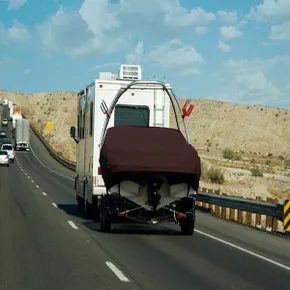

The Hardware You Actually Need
You might think A-frame tow bars are a no-brainer because they are the lightest, cheapest option on the table, but that doesn’t mean you can just bolt them on and hit the road. Proper installation is non-negotiable. If you want to avoid turning your sedan into a very expensive paperweight, you need to get this right. Most people, myself included, would hand this off to a pro. It is safer. It is more certain. But if you are the type who trusts their own wrench, here is what goes into the pile.
You will need a receiver hitch. The tow bar itself. Safety cables. A wiring kit. And a baseplate for the towed vehicle.
The baseplate is the anchor. It is specific to the car being dragged behind you. It bolts directly to the frame. Some cars fit out of the box. Others require surgery. You might need to cut a bumper. You might need to drill into the frame. The baseplate comes with the hardware to bolt it to a secure spot on the tow vehicle, but the fitment is rarely perfect for every single trim level. Do not assume it drops in like a Lego brick.
Safety cables are your fail-safe. They act as a backup mechanism. If the car becomes separated from the motor home for any reason, these cables catch it. One end attaches to the car. The other to the motor home. They are not for steering. They are for not losing your car.
Then there is the wiring. The kit allows the running lights, tail lights, brake lights, and turning signals of the towed car to operate in conjunction with the motor home. This is how you tell the driver behind you that you are braking. If you only tow occasionally, temporary kits are available. They attach with straps or simple wires. They are quicker to install and easier to remove. If you tow frequently, a permanent wiring job is better. Less maintenance. Less chance of something coming loose on a long highway stretch.
“The baseplate is one of the most important pieces because it’s specific to the car being towed and bolts to the car frame.”
For deeper dives into rigid A-frame tow bars, check the links on the following page. There is plenty of technical detail there that saves you from making expensive mistakes.
Lots More Information
Related HowStuffWorks Articles
- 10 Tips for Easy Towing
- How Trailer Towing Safety Works
- How Trailer Roof Vents Work
- How Towing Weight Distribution Systems Work
- Tow Bar Quiz
More Great Links
- Blue Ox
- Roadmaster
- RV Wholesalers
Sources
- Polk, Mark J., Explorer RV Insurance. “Dinghy Towing 101.” (10/14/2008) http://www.explorerrv.com/articles/DinghyTowing101.pdf
- Towbar.com. (10/14/2008) http://www.towbar.com/faqs.htm
- Walczak, Jim, About.com.”Towing Four Wheels Down.” (10/14/2008) http://4wheeldrive.about.com/cs/towing4wheelsdown/a/aa070601a_.htm