Walk up to a new luxury car, and the first thing that hits you is the visual noise. High-definition instrument clusters. Sweeping infotainment screens. Ambient lighting strips glowing in the door panels. It’s all designed to impress your eyes.
But the moment you slide behind the wheel, the show is over. The lights dim to your focus. Your eyes lock onto the asphalt. And suddenly, your relationship with the machine shifts entirely from sight to touch.
This is sensory ergonomics. Or, as Japanese automotive engineers prefer, Kansei Engineering. It’s the practice of translating abstract emotions and tactile sensations into concrete design specs. In a cabin increasingly dominated by cold, glass-like panels, texture is the new brand identity.
Why Material Pairing Matters More Than Specs
German premium manufacturers have been playing this game for decades. They know that luxury isn’t a monolith. It’s a contrast.
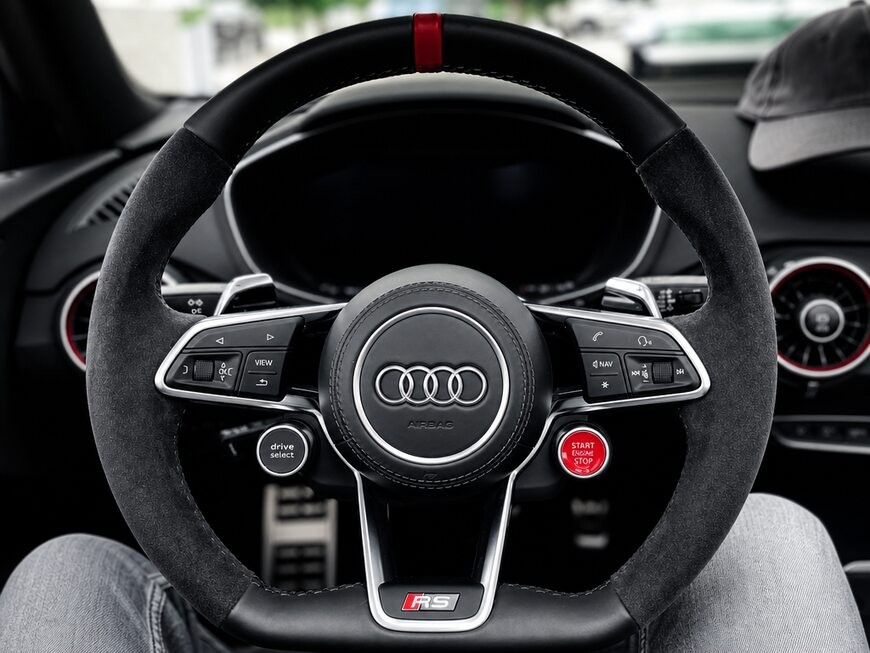
Look at Audi’s RS models. The interior is a calculated collision of hardness and softness. You get exposed carbon fiber and brushed aluminum for the visual kick. But the contact points? They’re wrapped in fine leather and synthetic suede.
It’s not random. Designers map the cabin by interaction intensity. Surfaces you stare at but don’t touch are kept matte and clean. This reduces eye strain during long hauls. Surfaces you grip, press, or slide your knee against? They get high-friction materials.
That’s why Audi Exclusive offers so many suede-wrapped options. The steering wheel. The gear selector. The knee bolsters. These spots need to feel grippy. Secure. Athletic.
If your hands are slipping on smooth leather, you’re distracted. You’re not driving. You’re fighting the car.
The Key Fob Gap in Premium Design
Here is where most OEMs fumble the handshake.
Consider your key. It’s the first thing you touch when you approach the car. The last thing you hold when you walk away. Car designers call this the “handshake loop.” It’s a threshold moment. You’re shifting modes from pedestrian to driver.
If you step into a cabin stitched with hand-sewn Nappa and premium microfiber, but pull a lightweight, hollow plastic key from your pocket, the illusion breaks. Instantly.
It feels cheap. It feels disconnected. It’s a jarring interruption of the quality you just experienced upon entry.
No wonder enthusiasts are customizing their keys. There’s a growing aftermarket industry dedicated to bridging this tactile gap. Owners want their pocket gear to match the cabin’s primary textures. It’s about consistency. Cohesion.
For RS owners, this often means seeking out custom key cases specifically designed for Audi. These aren’t generic holders. They use premium synthetic suede to match the RS steering wheel exactly. So even when you’re not in the driver’s seat, that physical connection to the cockpit remains intact.
Tactile Landmarks in the Touchscreen Age
It’s not just about matching colors. It’s about function.
AMG owners are doing the same with Mercedes. They’re replacing the standard plastic smart key casings with fitted covers that replicate the velvety texture of the performance steering wheels. Sure, it protects the key from pocket scratches. But it keeps the ownership experience aligned with the brand’s design philosophy.
This need for texture has grown sharper as interiors become more digital.
Physical buttons are vanishing. In their place are flat, glass touchscreens. Your hands are losing their tactile references. Adjusting climate control or volume used to be a blind operation. You felt for the ridges, the clicks, the detents. Now, you’re fumbling with sliders on a sheet of glass.
That’s a cognitive load issue. It’s a safety distraction. You’re taking your eyes off the road to find what you want to change.
Active haptic feedback on screens helps, but it’s not enough. Designers are fighting back with physical landmarks. Contrast is key. The distinct, fibrous nap of suede against smooth leather or hard plastic gives you a map you can read with your fingers alone.
You know where the controls are because your hands know the texture.
Modern luxury isn’t about horsepower anymore. Or screen size. It’s about how the vehicle feels in your palm and under your fingertips. It’s about a cohesive environment that feels connected.
The key is the logical starting point. It’s the bridge between you and the machine. Start there, and the rest of the drive follows.
Because once you get used to holding something that actually feels like part of the car, you realize you were missing something huge before. And you can’t un-feel it.