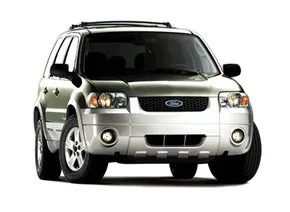
Hybrids have long reigned as the undisputed kings of fuel efficiency. They pair efficient combustion engines with electric motors and self-charging batteries. Before 2005, the segment was dominated by small cars. They lacked horsepower. They offered little cargo space. Enter the Ford Escape Hybrid.
It changed the game.
This SUV delivers up to 36 miles per gallon. It isn’t the absolute most efficient machine on the market today. But for an average family of four, the savings at the pump are significant. It proves you don’t need a tiny footprint to save money.
Зміст
How Hybrid Technology Works
Understanding the Escape Hybrid requires understanding the tech under the hood. A hybrid vehicle merges gasoline combustion with electric propulsion. It aims to fix the flaws of standalone systems. Gas cars produce emissions. They are loud. They burn expensive fuel. Pure electric cars face range anxiety. They require plug-in recharging. Their battery life was historically short.
A hybrid solves these issues. It uses a combustion engine and an electric motor working in tandem. The system switches between them or runs both simultaneously.
The Ford Escape Hybrid uses a parallel hybrid setup.
Both the gas engine and electric motor can propel the vehicle. The car never needs external charging. Braking generates energy. That kinetic energy stores power in the battery pack. If the charge drops critically low, the gas engine takes over. It runs until it recharges the batteries.
“A hybrid car has a combustion engine and an electric motor that work together.”
This design eliminates the need to plug in. It removes range anxiety entirely. You drive it like any other car.
Engineering the Escape
Ford took a pragmatic approach. They did not design a new car from scratch. They started with the existing four-cylinder Ford Escape. It is a relatively small SUV. Even without electric assistance, it earns 25 mpg on the highway. That is decent mileage for its class.
The engineering team spent five years on the project. One hundred engineers worked on the hybrid powertrain. Their goal was integration.
Visually, the change is subtle. The body remains recognizable as a standard Escape. You might spot a small “Hybrid” badge on the door. The dashboard gauge differs slightly. A rear vent helps cool the battery pack. Without these clues, most people would not notice the difference.
This was not a niche experiment. It was a massive engineering effort applied to a proven platform. The result was a vehicle that could compete in the mainstream market. It brought hybrid efficiency to a segment that previously ignored it.
The question remains whether this breakthrough would shift consumer behavior. Early data suggests a strong interest. But the real test lies in long-term reliability and real-world performance.
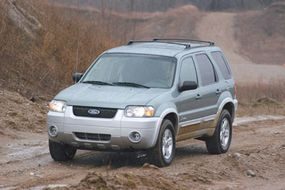
That was the whole pitch. Ford didn’t just slap a gas engine and a small battery together and call it a day. They spent years refining the Escape Hybrid because they needed it to behave exactly like a conventional SUV. You don’t need an engineering degree to drive it. You just turn the key.
The electric motor and battery pack are designed to last the life of the vehicle with zero maintenance. There is no dashboard gauge warning you that your charge is dipping. The system handles the switching between power sources internally. It is invisible. For all intents and purposes, the Escape Hybrid is simply an SUV with excellent mileage and low emissions. That simplicity is what could actually move the needle in the U.S. auto market. Making hybrid technology accessible to the average buyer without requiring a learning curve was its most innovative feature.
But what happens when you pop the hood? Let’s look at the hardware.
The Ford Escape’s Full Hybrid System
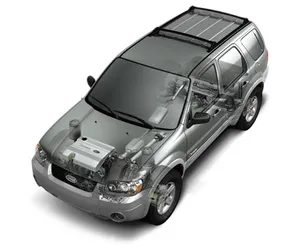
Underneath the plastic covers lies a complex dance of mechanical and electrical components. The heart of the system is not just a small electric motor assisting a larger engine. It is a fully integrated parallel hybrid system.
Ford used a 2.3-liter inline-4 gasoline engine. It is paired with a permanent-magnet synchronous electric motor. The two are coupled through a power split device, which is essentially a sophisticated planetary gearset. This setup allows the engine to drive the wheels directly or generate electricity to charge the battery. It also allows the electric motor to drive the wheels independently at low speeds.
The battery pack is a nickel-metal hydride (NiMH) unit. It sits under the rear seats. The capacity is modest by modern standards, but it provides enough energy for short electric-only bursts. The system manages the state of charge automatically. Regenerative braking captures energy that would otherwise be lost as heat. This energy is fed back into the battery.
The transmission is a continuously variable transmission (CVT) in all but name. The planetary gearset creates the variable ratio effect. This allows the engine to stay in its most efficient RPM range more often than a traditional automatic. The electric motor fills in the gaps. It provides torque when you need it and stores energy when you don’t.
Why This Matters for Drivers
Most drivers will never know the difference between this and a regular gas car. The transition between electric and gas power is smooth. There is no jerking. No lag. The system decides when to use which power source based on throttle input, speed, and battery charge. You are just driving.
This approach removed the barriers to entry. You didn’t need to learn how to “charge” the car. You didn’t need to worry about battery longevity. The car just worked. This is why the Escape Hybrid resonated with buyers who wanted the benefits of a hybrid without the hassle. It was a proof of concept for mass adoption.
The Real-World Impact
The Escape Hybrid didn’t just change how people thought about hybrids. It changed how Ford approached electrification. It showed that hybrids could be practical. Affordable. Easy to use. The sales figures proved that consumers were willing to embrace the technology if it didn’t require a lifestyle change.
The engineering behind the Escape Hybrid is a testament to Ford’s commitment to making electric mobility accessible. It wasn’t about creating a niche product for tech
How the Ford Escape Hybrid Actually Works
Forget the “mild” hybrids where the gas engine never really stops. Ford engineered the Escape Hybrid as a full system. The gas engine and electric motor don’t just take turns. They cooperate. You get separate operation, combined operation, and everything in between.
The system runs on four distinct phases.
Start with ignition. Turn the key. The electric motor wakes up first. It cranks the gasoline engine. Then comes the check. The computer scans battery charge levels. It checks operating temperatures. It verifies climate control settings. If the A/C is maxed out, the engine stays on. If conditions are right, the gas engine shuts off instantly. You’re now on electric-only power.
This happens in seconds.
When you hit a stoplight, the gas engine dies. You idle in silence. Waiting at the drive-thru? Silent. Ford smoothed out the on-off cycles significantly. Testers still noted a discernible shudder when the engine restarted or cut. It’s standard hybrid behavior. Don’t expect a Rolls-Royce whisper.
Acceleration is purely electric at first. The electric motor delivers instant torque at low RPMs. It’s the perfect tool for launching from a stop. The gas engine doesn’t engage until you hit roughly 25 mph. In heavy city traffic, you might go all day without the gas engine firing up once. The two power sources work in tandem up to highway speeds.
Then there’s regenerative braking.
Regular cars waste kinetic energy as heat when you brake. Hybrids capture it. The electric motor flips roles. It becomes a generator. It puts power back into the battery pack. Every red light is a mini-charge session. This is why hybrids crush gas mileage in stop-and-go city driving compared to open highways. Smooth braking matters here. Slam the brakes, and the anti-lock system takes over. You lose that recovered energy.
Highway cruising changes the dynamic.
At speeds between 50 to 70 mph (80 to 110 kph), the gasoline engine does the heavy lifting. It’s most efficient here. But the Escape has a small four-cylinder engine. It lacks raw power. When you need to pass, the electric motor kicks in. It adds horsepower to the gas engine. You get a boost without downshifting.
There is no traditional transmission with gears. The Escape uses an electronically controlled continuously variable transmission (eCVT). On-board computers constantly adjust gearing for optimal fuel efficiency. Ford engineers claim this results in a 30 percent efficiency increase over conventional gearboxes.
Now, let’s look at the price tag.
Escape Hybrid Pricing and Options
You can add about $3,800 worth of options to the Hybrid trim. Leather seats. Enhanced safety features. A 110-volt power outlet for laptops or tools. An appearance package. GPS navigation.
Here is the baseline pricing for the lineup.
-
Escape FWD 4-cyl. – $19,995
-
Escape AWD 4-cyl. – $23,235
-
Escape AWD 6-cyl. – $27,145
-
Escape Hybrid FWD – $26,970
-
Escape Hybrid AWD – $28,595
The Hybrid FWD sits just under $27k. It’s a premium, but not an outlier in this segment. The AWD hybrid jumps to $28,595. For most buyers, that’s the number that matters.
Next, we crunch the numbers to see if that premium buys you enough fuel savings to justify the cost.
Powertrain Architecture and Output Numbers
Ford didn’t just slap a battery in the Escape. They re-engineered the gas engine for efficiency. The hybrid uses a 2.3-liter, aluminum, four-cylinder Atkinson-cycle unit. Atkinson cycles sacrifice peak horsepower for better thermal efficiency. It’s a trade-off. Standard Otto-cycle engines are more powerful. Atkinson cycles are leaner.
The gasoline motor pushes out 133 horsepower at 6,000 rpm. Torque sits at 129 lb-ft at 4,500 rpm. The electric side is a three-phase, permanent-magnet, synchronous motor. It adds 94 horsepower, but only in the 3,000-5,000 rpm range.
Compare that to the non-hybrid Escape. Its four-cylinder makes 153 hp at 5,800 rpm and 152 lb-ft of torque at 4,250 rpm. The hybrid loses grunt on paper. It gains efficiency instead.
Weight and Dynamics
Mass kills efficiency. The AWD Escape Hybrid weighs 3,893 lbs (1,766 kg). That’s roughly 500 pounds heavier than the standard model. The hybrid components aren’t free.
The wheelbase is 103.1 inches. Ground clearance is a modest 8 inches. It’s compact for an SUV. Rubber meets road via Continental ContiTrac EcoPlus tires. A full-size spare is included. The fuel tank holds 15 gallons.
Performance Metrics
Car and Driver tested the fully optioned AWD model in December 2004. Here are the hard numbers:
- 0-60 mph: 10.8 seconds
- Top Speed: 102 mph (164 kph)
- 70-0 mph Braking: 195 feet (60 meters)
It’s not a race car. But it moves.
Fuel Economy Realities
If you’re shopping for a hybrid, you care about one number. Miles per gallon. The Escape Hybrid won’t hit the 50+ mpg marks of smaller compact hybrids. Ford rates it at:
- City: 35 mpg
- Highway: 29 mpg
Independent tests from USAToday and Motor Trend suggested real-world figures would be slightly lower. Still, the gain over the non-hybrid Escape is 20 to 25 percent. That’s significant. It also dwarfs larger SUVs that struggle to hit 10 mpg.
EPA ratings vary by drivetrain. The FWD version gets 33 mpg city and 31-36 mpg highway. The AWD drops to 33 mpg city and 29 mpg highway. With a 15-gallon tank, range sits between 400 and 500 miles. That’s enough to cross states without frequent stops.
Why City Driving Favors Hybrids
Combustion engines hate idling. They hate slow acceleration. They hate frequent stops. A heavy SUV doing stop-and-go traffic burns fuel inefficiently. You’re burning gas just to overcome inertia.
Hybrids solve this. The electric motor handles low-speed movement. No gas is burned when creeping in traffic. Braking regenerates energy. The battery recharges.
This is why hybrid city mileage exceeds highway numbers. On the highway, the combustion engine does most of the work. In the city, the electric motor shines.
Driving Impressions
How does it feel to drive?
The transition between electric and gas power is smooth. You barely notice the switch. At low speeds, it’s quiet. Electric-only mode dominates in traffic jams.
Acceleration feels adequate, not urgent. The electric motor provides instant torque off the line. The gas engine kicks in when you need more power. The system manages the handoff seamlessly.
Braking feels different. Regenerative braking adds resistance. You have to adjust your foot pressure. It takes a minute to get used to.
Handling is stable. The extra weight lowers the center of gravity slightly. Body roll is minimal. The Continental tires provide good grip.
Inside, the cabin is quiet. Wind noise is minimal. The hybrid system doesn’t whine or buzz. It’s refined.
Is it fun to drive? Not really. It’s practical. Efficient. Quiet. It prioritizes savings over sportiness.
For most buyers, that’s the point.
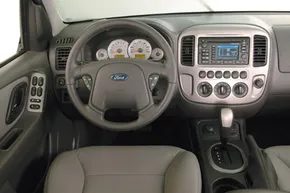
Most of the time, you’d never guess you were behind the wheel of a hybrid. Ford engineered the Escape Hybrid to mimic the behavior of a standard compact SUV so closely that the electric drivetrain remains largely invisible. If you didn’t know the specs, you wouldn’t notice the electric motor helping out.
But drive it hard enough, and the quirks start to show up.
The Shudder and the Brake Feel
The most immediate giveaway is the shudder. It happens when the gasoline engine kicks back in after the car has been coasting or running on electric power alone. It’s a slight jerk you feel through the seat of your pants. It’s not violent, but it is distinct from the smooth pull of a conventional internal combustion engine.
Then there is the braking. Regenerative braking uses the electric motor to slow the vehicle, recovering energy in the process. This means the deceleration feels different. You aren’t just relying on friction pads grinding against rotors. You feel a change in resistance before the physical brakes engage. On a hard stop, there is a noticeable transition point where the hydraulic brakes take over to bring the car to a complete halt. It requires a light adjustment in your right foot.
The eCVT Advantage
The biggest upside comes from the transmission. Ford equipped the Escape with an electronically controlled continuously variable transmission (eCVT). Unlike a traditional automatic with fixed gears, this system has no physical gears to shift.
The result is a ride that feels incredibly smooth. There are no sudden jolts when the car accelerates. No clutch engagement. No RPM spikes that feel like a kick. The power delivery is linear. You press the pedal, and the car moves. Period.
This smoothness is one of the main reasons for the reported fuel efficiency gains. The engine stays in its optimal efficiency range more often because it doesn’t have to jump between gear ratios. The eCVT manages the power split between the gas engine and the electric motors to keep things rolling efficiently.
Is it a sports car? No. But for daily commuting, the lack of shift shock makes it one of the smoother small SUVs on the road. You just have to get used to the brake pedal feeling a bit different at first.
The Dashboard Tells a Story
The instrument cluster barely changes, except for one specific tweak on the tachometer. You will see a reading that dips below zero. It is a clever little indicator that tells you the internal combustion engine has shut off and the car is running on electric-only power. If you opt for the navigation system, you get a bonus: the display screen includes a hybrid power flow graphic. It shows exactly how energy is moving through the system in real time.
Where Do the Batteries Hide?
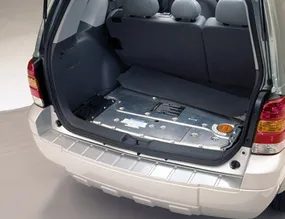
It is easy to assume that packing enough batteries to push a small SUV forward would eat up the entire trunk. The engineering team at Ford disagreed. The Escape Hybrid uses 250 D-size nickel-metal hydride cells. They are connected in series and lie flat beneath the rear cargo area.
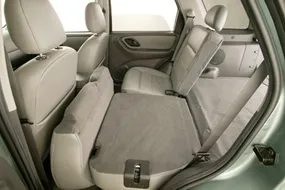
Because of this placement, the cargo space is smaller than in the non-hybrid Escape. The loss is only a few inches. For the driver and passengers, everything remains unchanged. There is no sacrifice in comfort or headroom.
Is It Worth the Switch?
As a first attempt at a practical hybrid SUV, the Ford Escape Hybrid stands out as excellent engineering. It is better for the environment and offers lower fuel costs than any other SUV currently on the market. It does not quite match the Toyota Prius, which holds a rating of 60 mpg in the city and 51 mpg on the highway. But the Escape might be better for the planet in the long run. By building a hybrid for the average family, Ford could help put millions of these vehicles in American garages within a decade.
“By making a hybrid for the average family, which generally needs a bit of room to travel comfortably, Ford could be helping to put millions of hybrids in American garages within a decade.”
Explore Further
For more details on the Ford Escape Hybrid and related automotive topics, look to the following links.
Related HowStuffWorks Articles
- Quiz Corner: Hybrid Car Quiz
- How Hybrid Cars Work
- How Electric Cars Work
- How GM’s Hy-wire Works
- How the Hydrogen Economy Works
- How Car Engines Work
- How Electric Motors Work
- How Gas Prices Work
- How Natural-gas Vehicles Work
- 2007 Hybrid Car Pictures
- Consumer Guide’s Real World Fuel-Economy Champions
More Great Links
- Ford Vehicles: Escape Hybrid
- Ford Vehicles: Escape Hybrid: Fuel Cost Savings Calculator
- HybridCars.com: Early Impressions of Escape Hybrid Driver
- A Family Car Road Test: 2005 Ford Escape Hybrid
- TomPaine.com: Escape From Oil Addiction – August 12, 2004
Sources
- Chirico, Neil. “First Drive: 2005 Ford Escape Hybrid.” Motor Trend, Aug. 2004.
- Healey, James. “Ford goes hybrid with promising new Escape.” USAToday.com, 5/13/2004.
- Sessions, Ron (editor). “Motor Trend 2005 & 2006 Sport/Utility, Truck & Van Buyer’s Guide.” Motor Trend, Nov. 2004.
- Vanderwerp, Dave. “After a million man-hours, Ford cranks out the first hybrid SUV.” Can and Driver, Dec. 2004.
- Ford Vehicles: Escape Hybrid